Marina Square at 40: From retail anchors to sporting communities
The shift toward a mixed-use, experience-led waterfront precinct signals developer confidence and could support demand for its luxury homes, offices, hotels and surrounding Marina Bay properties.
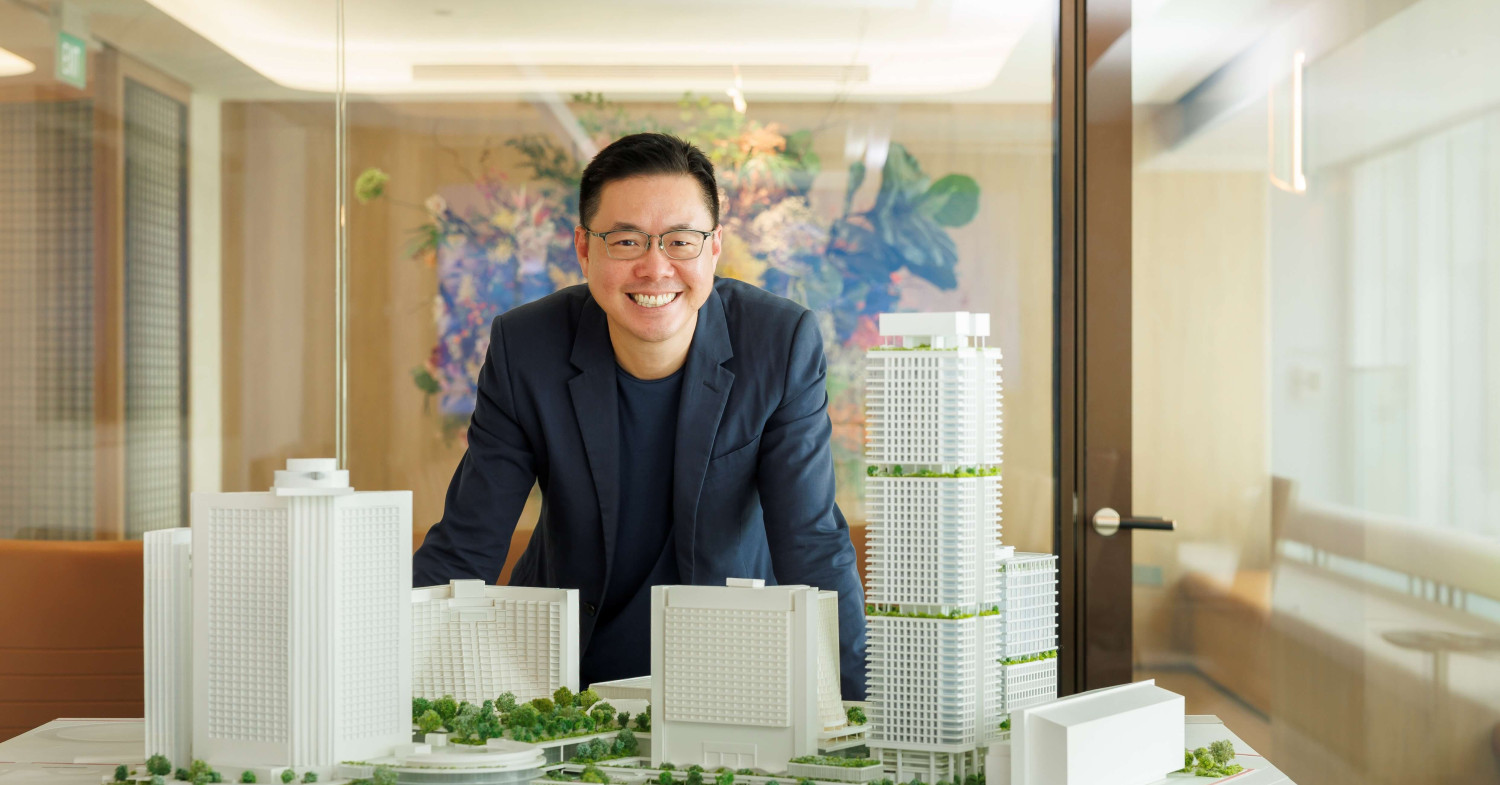
SingLand will close Marina Square on March 31, 2027, for a partial redevelopment that increases precinct GFA 15% and adds three towers, including 204 luxury apartments.
Body
Forty years ago, department stores such as Metro and Tokyu were among the anchors that drew shoppers to Marina Square. For its next chapter, Singapore Land Group is betting on a different kind of anchor: experiences rather than retailers.
The idea resonates personally with Singapore Land Group (SingLand) CEO Jonathan Eu.
He envisions converting the mall rooftop into a landscaped racquet club with pickleball and padel courts. “These are social, community sports that have gained strong traction, not just in Singapore but globally,” says Eu.
But sport is just one part of a broader ambition to reimagine Marina Square as an intergenerational destination.
Read also: Orchard Road must double down on community and experiences to remain Asia's premier lifestyle destination
As SingLand prepares to partially redevelop the 9.2ha site — equivalent to about 13 soccer fields — Eu wants the mall to become a place where children, parents and grandparents can exercise, dine, socialise and spend time at different points throughout the day.
Another key feature will be a new 4,000 sq m (43,056 sq ft) sheltered event space facing Esplanade – Theatres on the Bay. The flexible space could host activities such as badminton, basketball and table tennis, serve as a start-and-finish point for running and cycling events or triathlons, or accommodate other community events.
“What we want are inclusive sports communities, and it could be any sporting community — from Hyrox to cycling or running,” says Eu. “I love sports, so again, it’s a natural extension of what I really believe in and why.”
Sports recovery, wellness and longevity could also complement the sporting focus, with such operators becoming future tenants at the mall. “We see a lot of synergies there,” he adds.
How the mall evolved
The new concept reflects a broader shift in what people expect from shopping malls.
The original Marina Square complex was conceived around a US-style mall format, with four major anchors positioned around a square and smaller shops in between.
When Marina Square opened in 1986, it had about 59,000 sq m of retail space and was said to be the largest shopping complex in Southeast Asia.
Read also: Marina Square to transform into 'hyper-mixed' 24/7 destination with living, hospitality, office, retail, sports, wellness, culture: SingLand
By the late 1980s, its anchors included the department stores Metro and Tokyu, along with a supermarket and about 220 shops. It also had Eng Wah Cinemas, an open-air food court and the Magic Land arcade. Its outdoor steps became a popular gathering place.
As shopping and leisure habits evolved, so did Marina Square. In 1996, the Marina Leisureplex opened with a six-screen Golden Village cineplex and the SuperBowl entertainment centre, which included an indoor games arcade, bowling alley, snooker and billiards facilities.
“I’ve had interesting memories of the place as a youth,” says Eu. “I remember elements of it — the bowling alley, cinema and, of course, the steps.”
A $100 million makeover from 2004 to 2006 reorganised the mall into themed zones and introduced new retail and dining concepts.
A decade later, a further $95 million asset enhancement from 2013 to 2015 introduced concepts such as The Dining Edition, Emporium Shokuhin — a large Japanese food emporium and supermarket — and children’s attraction Pororo Park. Kiztopia, an indoor ‘edutainment’ playground, arrived later.
But periodic makeovers and tenant refreshes are no longer enough. “In this day and age, with the rise of online shopping and changing consumer behaviour, the traditional anchor-retailer model has become less relevant,” says Eu.
Read also: What the office model cannot see
Five years in the making
A catalyst for change came in April 2019, when SingLand (then listed as United Industrial Corp before its rebranding in 2021) increased its interest in Marina Centre Holdings to 77.34%, with parent UOL Group holding the remaining 22.66%.
Marina Centre Holdings developed Marina Square and continues to own the complex.
The consolidation gave SingLand and UOL an opportunity to “think more deeply about what we could do to unlock the potential of Marina Square”, says Eu.
It also prompted the group to reinvest in the three hotels linked to the mall: the 790-room Pan Pacific Singapore, the 533-room Parkroyal Collection Marina Bay (formerly Marina Mandarin Singapore), and the 510-room Mandarin Oriental Singapore.
At the same time, the group began rethinking the future of the wider Marina Square precinct.
The first meaningful discussions with URA took place in 2021. “I would say it’s been a five-year journey from the start to where we are today,” says Eu.
The design went through many permutations and “different levels of iterations” over those five years. At one stage, the group even considered completely redeveloping the entire 9.2ha precinct.
After discussions with URA, however, it arrived at a plan that balanced adaptive reuse with partial redevelopment.
Preserving Portman’s design
Retaining significant portions of the existing development allows SingLand to preserve an important piece of Marina Square’s architectural character.
Marina Square and the three hotels connected to it were designed by the late American architect John Portman, best known for expansive atriums, terraced balconies and dramatic interior spaces.
Portman designed four hotels in Singapore in the 1980s: the three Marina Square hotels and the former Regent Singapore, rebranded as Conrad Singapore Orchard in 2023.
“If you build a new hotel today, you will never get the same design with those large, beautiful atriums because they will not fulfil the current design guidelines,” says Eu. “We decided to preserve the original form of the structure, and add new buildings that are respectful and respond to [Portman’s architecture].”
SingLand and UOL appointed London-based PLP Architecture as design architect for Marina Square, in collaboration with local firm DP Architects.
The relationship with PLP began with UOL’s One Bishopsgate Plaza in London. Completed in 2021, the 43-storey mixed-use development combines Pan Pacific London, luxury residences and the restored Victorian Devonshire House.
The relationship subsequently extended to Singapore, where PLP designed The Clifford, SingLand’s redevelopment of the former Clifford Centre in Raffles Place.
Scheduled for completion in 2028, the new 35-storey, 220m-tall The Clifford will have 360,000 sq ft of premium Grade A office space and 45,000 sq ft of retail and F&B offerings.
“It has become a great partnership and friendship,” says Eu.
For Marina Square, SingLand wanted a design architect that understood what the group was trying to achieve and could translate that ambition into the built environment. PLP “was the right fit”, he adds.
Marina Square is the latest in a series of major asset enhancement initiatives (AEIs) undertaken by SingLand, following those at Singapore Land Tower and West Mall, both completed last year.
According to Eu, the current scheme emerged after “many twists and turns”. The most significant part of the partial redevelopment, he says, is the repositioning of the mall because “it cuts across so many components and connections”.
Turning the mall inside out
Characteristic of enclosed malls built in the 1980s, Marina Square is largely inward-looking.
Under the redevelopment, the existing four-storey retail mall will undergo a comprehensive AEI across more than 76,000 sq m (818,057 sq ft) of gross floor area (GFA).
It will essentially be turned inside out. The ground-floor carpark will become an outward-facing active zone, with a 24-hour through-block connection improving access across the precinct.
“The mall will remain the main nucleus of the entire precinct, as it will be connected to all the surrounding buildings,” says Eu. “Even today, all three hotels are connected to it, with two of them — Mandarin Oriental and Parkroyal Collection Marina Bay — sitting on top of the mall.”
While the mall will be “right-sized”, its refreshed offerings will include a broader mix of F&B, sports, wellness and lifestyle concepts, as well as landscaped and pet-friendly spaces. There will also be an elevated Botanical Loop linking a series of gardens.
New pedestrian links at both ground and elevated levels will also improve access to surrounding buildings, transport infrastructure and the wider Marina Centre precinct. Marina Square is currently linked to Esplanade MRT Station via the basement-level Marina Link walkway.
Along Raffles Avenue, the area above Stamford Canal will be transformed into a 6,500 sq m public park with planting, playscapes and event spaces. Overall, between 60% and 70% of the site area will be devoted to greenery and landscaping.
Why the mall has to close
The extent of the works means the mall will close on March 31, 2027, to facilitate construction.
Eu says the group spent considerable time assessing the alternatives, including partial and selective closures. However, because different parts of the complex are structurally interconnected, a full closure was ultimately deemed necessary to carry out the works. “We don’t take the decision to close the mall lightly,” he says.
The three existing hotels, however, will remain operational throughout the redevelopment, with SingLand working with the hotel operators to maintain access and minimise disruption to guests.
The AEI forms part of SingLand’s partial redevelopment of Marina Square under URA’s Strategic Development Incentive scheme, for which Written Permission was granted on Aug 31, 2026.
The total GFA of the precinct will increase from about 3.4 million to 3.9 million sq ft, excluding bonus GFA for balconies and indoor recreation spaces. That represents an increase of about 15%.
Three new towers
Beyond the mall, three new towers will be added to the precinct: a 49-storey residential tower with 204 luxury apartments; a 24-storey block with 260 serviced apartments; and a 19-storey mixed-use block comprising a new 304-room hotel and offices.
The new hotel will increase the number of hotel rooms across Marina Square from 1,833 to 2,137. Eu does not expect it to cannibalise demand from the existing hotels. Instead, he sees it as complementary to the broader precinct.
“We’re very clear about where all three existing hotels sit in terms of market segment and customer profile,” he says. “We own and operate Pan Pacific and Parkroyal Collection Marina Bay, which are both our brands. And Mandarin Oriental is a long-term partner.”
At the mixed-use block, the hotel will occupy the fourth to 10th floors, followed by communal spaces at the 11th-storey sky terrace. Grade A offices will occupy the 12th to 19th floors, with floor plates of about 20,000 sq ft.
The offices will have uninterrupted views towards the Esplanade, Marina Bay and parts of the Civic District. “We believe these vistas will create value for the office space,” says Eu.
The 49-storey residential tower, meanwhile, will contain 204 units, predominantly three-, four- and five-bedroom apartments, as well as penthouses.
They have been designed primarily for owner-occupation, whether as a primary or secondary home, with layouts intended to capitalise on the views, Eu notes.
Marina Square is the single biggest redevelopment fronting the wider Marina Bay area. For Eu, it represents a rare opportunity to reshape an entire precinct while retaining much of its existing urban fabric.
“It’s one of those things that you don’t get the opportunity to do very often,” he says.
SingLand has yet to decide whether the Marina Square name will be retained. “When you go through a process of brand development, you assess whether the historical legacy and the brand equity still make sense,” says Eu. “Or if you’re repositioning something, is it better to have something fresh?”
The redevelopment is targeted for completion in early 2031, although parts of the project are expected to be completed in phases.
A changing Marina Bay
The redevelopment is also unfolding as the wider Marina Bay area enters another phase of transformation.
Directly across the road, NS Square is being built on the site of the former Float @ Marina Bay. The new waterfront venue will have a permanent stage and a 30,000-seat grandstand for major national and community events, including future National Day Parades. It could open towards the end of 2027.
Across the bay, Marina Bay Sands is undertaking an estimated US$8 billion ($10 billion) expansion. Designed by Safdie Architects, which also designed the original integrated resort, the project will include a 55-storey, 570-suite luxury hotel tower crowned by a multi-level Skyloop, a 15,000-seat entertainment arena and about 200,000 sq ft of MICE space, as well as new dining, retail and nightlife offerings.
Construction of the Marina Bay Sands expansion is expected to be completed in June 2030, with opening targeted for January 2031, subject to government approval.
Gardens by the Bay is expanding too. Its planned 5ha Wetlands by the Bay will extend the existing Kingfisher Wetlands with new green spaces, a cantilevered canopy boardwalk and a teamLab museum featuring an indoor-and-outdoor pedal-kayak experience.
Construction is expected to begin in 1Q2027, with progressive opening targeted by end-2028.
For Eu, these developments reinforce the opportunity to position Marina Square not simply as another mall or mixed-use development, but as part of a larger waterfront destination.
For all the planning that has gone into the project, however, Eu says the real test will come only when people begin using the completed precinct.
“The proof is in the pudding,” he says. “At the end of the day, when it’s completed, when people use it and experience it, that will be a true testimony as to whether we got it right.”