Painting robots and heritage buildings: Wee Hur Construction's Andy Lu on tackling complex projects
The sizeable mixed-use commitment signals developer confidence in Upper Thomson, while its future housing and retail supply could broaden buyer choice and strengthen local amenities.
Wee Hur and GSC Holdings secured the 262,875 sq ft Upper Thomson Road site for $613.94 million, enabling about 595 homes and 21,527 sq ft of commercial space.
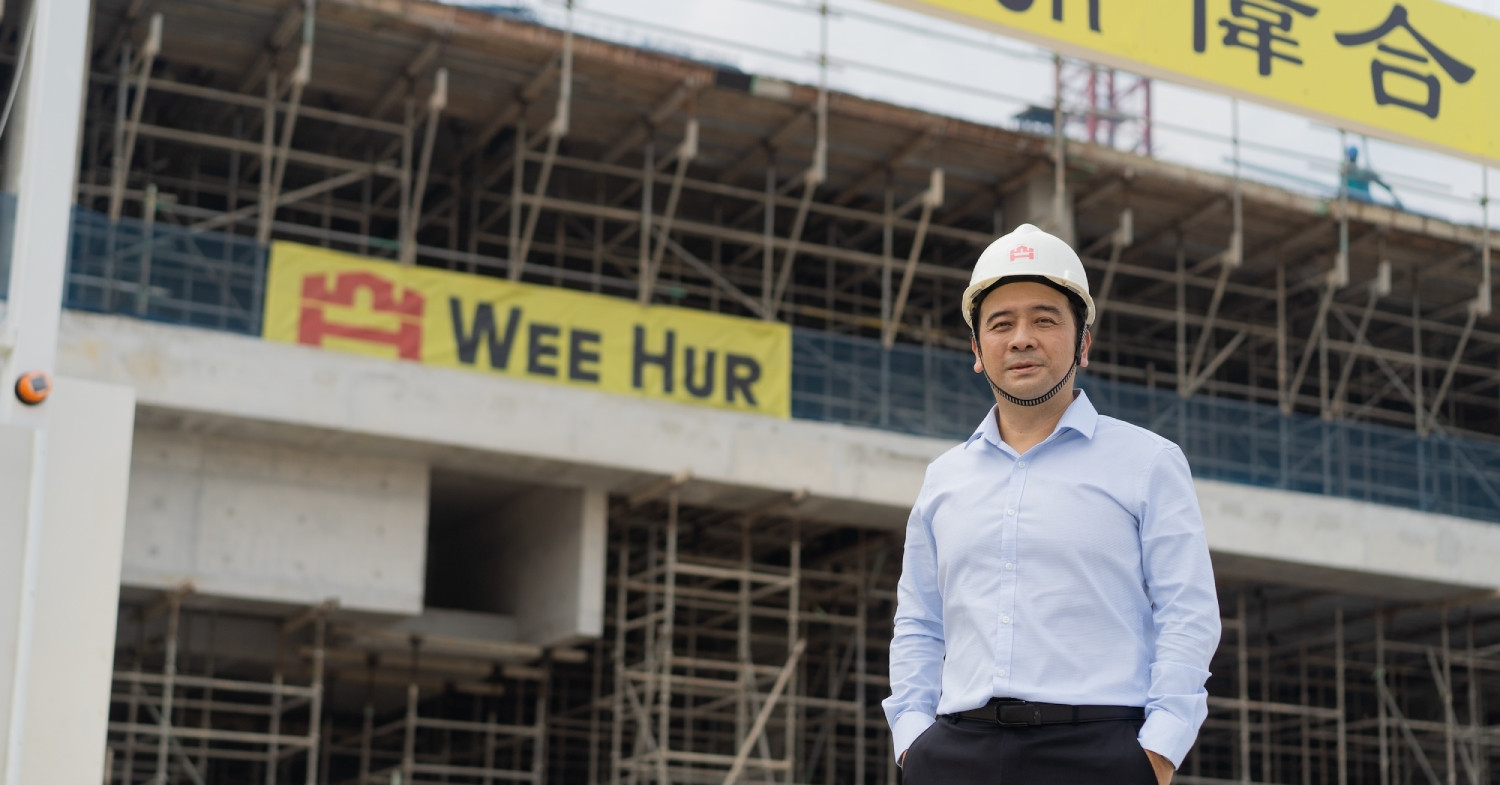
Body
A water pipe more than a metre in diameter lay beneath one of Wee Hur Construction’s project sites — except it was not where the project team had expected to find it.
"We have faced projects where huge water pipes were running through our sites," Andy Lu, CEO of Wee Hur Construction, tells EdgeProp Singapore.
For that project, the location of the pipe meant the team had to change the basement’s design and also divert the pipe at their own cost.
Read also: Elevate Capital gives 30-year-old Stamford Court a new lease of life as Stamford Place
The episode illustrates the uncertainties that can come with projects with deep basements. Underground pipes, cables and other utility lines are difficult to predict, as they may be live or abandoned, and could also be located differently from what existing records and drawings indicate.
"In construction, we are always very mindful of things that are unknown," Lu says. "We do not always know what is below ground, since we can’t see it."
Wee Hur tries to identify and resolve potential issues as early as possible, including checking existing underground services, confirming whether they are still in use and arranging diversions where needed before construction works start.
"These have to be done upfront, and the process is sometimes very tedious," Lu notes.
He says each project adds to the experience that the company can bring to subsequent jobs, even when the building type or site conditions are different.
Building and innovating through two decades of change
Lu joined Wee Hur in 2006 as an assistant project manager, and has helmed the construction arm as CEO since 2024.
Over that period, the company has expanded from a build-only contractor into a group with businesses spanning property development, property investment, fund management and purpose-built student accommodation.
Read also: Developers urged to create more family-friendly spaces, malls and homes; AC framework updated
Wee Hur Construction has taken on projects including private and public housing, workers' dormitories, schools, nursing homes, commercial developments, religious buildings, conservation works, as well as additions and alterations (A&A).
Lu observes that the way construction projects are planned and built has also evolved markedly across the industry over the past two decades, with far more coordination now taking place before work begins on-site.
Project teams use 3D Building Information Modelling (BIM) and digital platforms to get a clearer picture of a building and work through design and construction requirements earlier.
"With all these technologies, we are able to recreate the model of the building, and can better visualise the end-product even before we start the construction work on-site," he says.
The company is applying these tools across its current pipeline, which span a range of building types and construction requirements.
These include the Wycombe Abbey School (Singapore) in Hougang, A&A works at the historic Teochew Building along Tank Road, and the upcoming residential and commercial development on Upper Thomson Road.
Read also: Govt reviewing GFA guidelines, looking to speed up clearances for start of works; eyes night-time economy
These new projects range from fitting an elevated football field, competition-standard swimming pool and theatre within one school campus, to integrating new construction with an existing heritage building.
Classrooms, sports and the arts on a school campus
Slated to open fully by September 2028, the Wycombe Abbey School on Hougang Avenue 3 broke ground this January.
It is developed by Wee Hur with joint venture partners BE Education, a UK-focused admissions consultancy firm, and premier British boarding school Wycombe Abbey.
The co-educational day school, for students aged two to 18, will come with not just classrooms but also an array of facilities to support co-curricular activities such as sports, visual and performing arts, and innovation.
"This project combines a lot of different facilities, each with its own unique challenges," Lu says.
For instance, it will feature an Olympic-sized competition pool, which means the team has to adhere to prescribed World Aquatics standards and dimensions.
"There's also an elevated football field on the second storey [in the preliminary design], as well as a full on-premise kitchen and canteen serving the whole school population. These are aspects not normally seen in a typical project," he adds.
Besides, the music rooms, dance studio and theatre require acoustic treatment to prevent sound from disrupting classes and other activities.
The theatre in particular is a sizeable auditorium with a full stage and fly bars — an overhead system used to raise and lower stage equipment such as scenery and lighting during performances.
Lu says the team also has to consider circulation within the school, including how students move between different areas.
Some of the facilities, such as the library, swimming pools and sports amenities, will also be open to the public during off-peak hours when not in use by students.
With so many uses to accommodate on the site, some are stacked across different levels.
An example is the elevated, full-sized football field that may potentially sit above the swimming pool, gym and badminton courts on the level below — a design that Lu says will "make better use of the space" available within the plot of land. The field's placement on the second storey is subject to change in the final design.
Wee Hur is bringing experience from earlier similar education-related projects to the development.
These have included building swimming pools, a sports field and basement halls for United World College of South East Asia's Dover campus, as well as an administration building and a hostel block for the Insead Asia campus in Ayer Rajah in the 2000s.
More recently, Wee Hur constructed a new 11-storey block with sports and recreational facilities at Tanglin Trust School on Portsdown Road.
Opened in early 2023, and named the Tanglin Centenary Building, the block houses a 15m climbing wall, Olympic-standard gymnastics centre, an aquatic centre with a 50m swimming pool, gym, recording studio, recital room and music rehearsal halls.
"From all these projects, we learnt the requirements and execution, and how to get them right," Lu says. "We’re using all that we've learnt to tackle challenges at the Wycombe Abbey School project as well."
Planning for multiple uses
Meanwhile, at the Upper Thomson Road mixed-use development, a basement car park will sit below a first storey containing an early childhood development centre, shops and supermarket, while residences are housed from the second storey upwards.
Wee Hur and its largest shareholder, the Goh family-controlled GSC Holdings, snagged the 262,875 sq ft site when they jointly submitted the top bid of $613.94 million in the Government Land Sale tender last October. It can yield about 595 new homes and 21,527 sq ft of commercial space.
For the group's construction arm, this means designing and planning for various typologies with diverse space requirements.
"For a residential unit, you typically have smaller spaces for the bedrooms, living room and so on, so the walls are spaced quite closely to one another. But when you go down to the supermarket, you can’t have walls every 2m," says Lu.
Each layout calls for careful planning of the building’s grid and supporting structures.
The mechanical, electrical and plumbing systems also have to be planned separately for each area, while some services are eventually combined. Wastewater discharge from various parts of the building may feed into the sewer, for example.
Clients, subcontractors and trade specialists therefore have to come on board early to "thrash out" how the design, space planning and technical systems will work together, he says.
"We have to solve very different problems at the same time and fully coordinate the requirements upfront for submission, before we can get approval to commence works on-site," Lu adds.
Giving old buildings a new lease of life
He finds conservation work especially rewarding for what can be preserved through the construction process.
"It's very meaningful because these buildings carry a lot of memory, and we are able to retain that," he says.
One of Wee Hur's ongoing A&A projects is the Teochew Building, located on the edge of River Valley. Built in 1963, the heritage property's six-storey front portion — with its distinctive Chinese roof and facade — is being conserved, while the shorter structure behind it is demolished and rebuilt.
The works include excavating a new basement carpark and reconstructing the rear portion to six storeys to match the front block.
To retain the front of the Teochew Building, Wee Hur has to protect and strengthen the existing structure, including underpinning it with piling works from within the building.
Demolishing and rebuilding the entire property would in fact be faster, easier and cheaper than conserving it.
"It's difficult, but at the end of the day, we have to make sure this heritage building is retained so that we do not lose a piece of history there," Lu notes.
Older buildings can also reveal details only after construction has started.
Original hand-sketched construction drawings may be incomplete or unavailable, while the condition and location of existing structures, pipes and other building services can become clearer after ceilings and finishes are stripped away.
Laser scanning technology helps Wee Hur capture the dimensions and existing services within such properties without relying on manual measurement and drawings.
"We can just scan it and visualise what is there very quickly," Lu shares.
Being selective with technology
Technology now plays a growing role in Wee Hur’s construction operations, although Lu is selective about which solutions the company adopts.
With a steady stream of new products entering the market, Wee Hur often meets technology vendors and solution providers to understand and keep abreast of the latest advancements.
"Sometimes it’s not easy to decide. But we stay grounded, prudent and are guided by what we actually need," Lu says.
"What problem or pain point are we trying to solve? We do not adopt for the sake of adopting. We do not want to spend money unnecessarily and do everything."
When the company identifies a potentially useful product, it trials the technology first to see whether it works as intended. Wee Hur may also provide feedback to the vendor, which Lu says can help improve the product.
Among the tools already in use are 360-degree cameras for progress tracking. A worker walks through the construction site daily with the camera to capture images, which an AI platform analyses and stitches together to give project managers and senior management a virtual view of progress.
The images can also be compared over time and against the project's BIM 3D model to check whether the completed works correspond with the design.
"This is very powerful. It enables our people to compare and take action where necessary, such as getting the subcontractor to put in more resources," Lu says.
Additionally, Wee Hur uses a cloud-based common data platform to store, communicate and share project information among developers, consultants, architects and subcontractors.
Drawings, requests for information, submissions and approvals can be handled through the platform, with each action time-stamped so that parties can easily track its status and who submitted what.
Engineers can access the same platform on tablets to refer to drawings and models and fill in digital inspection forms, which can then be signed digitally, without having to carry stacks of printed plans around.
Meanwhile, the company's AI-enabled video surveillance system flags potential safety breaches, such as if a worker standing below a load being hoisted by a tower crane, and sends the safety officer an alert and video clip for faster intervention.
In tandem, vehicle safety technology on heavy machinery, such as excavators and cranes, includes proximity sensors and cameras that warn operators and workers when people get too close.
A fatigue monitoring system also alerts operators when it detects signs of sleepiness.
Wee Hur has turned to robotics too, using it to paint the basement ceiling at the new Mount Vernon Funeral Parlour Complex project.
Lu stresses that technology and AI still need to work alongside people, as human input is needed even as more tasks are automated.
For example, with painting robots, workers still have to prepare and protect the area beforehand, operate the robot and complete any touch-ups at the areas it cannot reach.
Building capabilities for bigger, more complex projects
Looking ahead, Wee Hur is studying where technology can take its construction operations next, including reducing the industry's reliance on diesel-powered equipment.
The company is now exploring electrification as an alternative for its heavy machinery.
"All our projects are already using battery energy storage systems to cut down on diesel use and carbon emissions, and we’ve started using solar panels on the roof of the site office," Lu says.
"So the next stage is to look at whether we can use the likes of electrical excavators and electrical dump trucks."
That said, construction firms will need sufficient grid power early enough at their sites to charge the machinery, for electrification to become a viable option.
"We have surfaced these issues to the government agencies. We are working together to see how to solve this so that it makes more sense for contractors to adopt the electrification of machinery," he adds.
Strengthening Wee Hur's engineering team is another priority for Lu, who hopes a deeper talent pool will enable the contractor to take on bigger and more complex projects while maintaining its standards.
He also sees technology as one way to make construction more appealing to younger engineers, who are already accustomed to working with digital tools.
After 20 years with Wee Hur and projects spanning housing, schools, workers' accommodation and conservation, there is still one building type Lu would like to add to the construction firm's track record: a large-scale commercial development.
"We've done many types of projects, and we are always very keen on things that we have not really gone into," he says.
"Maybe it's a dream, but hopefully one day we can take on a mega commercial project."