Why some young Singaporeans are opting out of the homeownership path
This shift signals rising demand for flexible, serviced accommodation and could broaden the long-stay tenant base while easing purchase urgency among some younger buyers.
A small but growing cohort of higher-income Singaporeans aged 20 to 40 is deliberately choosing long-term renting, co-living or other flexible arrangements over homeownership.
Body
[object Object],[object Object],[object Object],[object Object]
They earn well, have healthy savings and could easily be putting a deposit on a home right now — but they are not.
In most conversations around Singapore property, those who do not own are assumed to be either saving up, waiting for the right moment or priced out.
A small but growing cohort of higher-income locals in their 20s to 40s belong to none of these categories. They have looked at the homeownership path and decided it is not for them.
Read also: What goes into a home designed for ageing in place
While there are no official figures on the size of this group, conversations with industry players and locals who shared their experiences with EdgeProp Singapore point to a distinct, if still niche, segment.
Ownership as the norm
In Singapore, owning a home has meant more than having a roof over one’s head. It is widely seen as a milestone of success and independence, and a source of financial and psychological security.
The idea of homeownership is "quite ingrained" as a status marker of adulthood and financial or social independence, as well as an ideological marker of one’s urban and national status in Singapore, says George Wong, assistant professor of sociology at the Singapore Management University (SMU).
That is reflected in the nationwide homeownership rate, which has hovered at around 90% for years — among the highest in the world.
Over decades, this has given rise to a familiar trajectory: a couple ties the knot, buys a flat, starts a family, and, as incomes rise, upgrades to private property.
For many, that has served them well. But a younger generation is gradually finding value in other routes to a secure, fulfilling life.
Read also: More diverse housing types may be on the cards as Singapore's younger residents seek flexible rental options
Who are living differently
Those stepping off the conventional path are not a homogenous group.
While a minority, this subset is "very diverse and highly agentic", with a wide range of motivations and circumstances around why they choose not to own, says Wong.
Some are long-term renters in private residential properties, content to pay for flexibility instead of committing capital.
Others prefer co-living for its furnished and community-oriented spaces. A number live in serviced apartments or hotels on extended stays, prioritising the comfort and convenience of fully serviced living, premium amenities and a central location.
Some remain in the family home — valuing the lifestyle, space and close relationships it affords.
Then, there are globe-trotting professionals and digital nomads who split their time between Singapore and elsewhere, alongside those who own property abroad but rent while in Singapore.
More generally, many younger HENRYs ("high earners, not rich yet") — typically under 40 and earning $10,000 to $15,000 a month — have the financial flexibility to put homeownership on the back burner.
SMU's Wong reckons they may only begin thinking about a purchase when certain life milestones fall into place: a committed relationship, marriage or starting a family.
Read also: Ascott inks management agreements for nine Vietnam properties in 1H2026, expects momentum to continue
Others may have certain financial goals or careers that are top of mind rather than homeownership.
How they make it work
Megan*, a single professional in her 30s, has not had a permanent address for nearly a decade.
She lives in a rotation of luxury hotels in Singapore and abroad, enrolled in loyalty programmes or using friends-and-family discounted rates.
That gives her housekeeping, hotel amenities, dining privileges, room upgrades and other perks, including at affiliated properties overseas.
She travels light and moves often. Her larger, more valuable belongings sit in a self-storage unit. "I basically live out of a suitcase. It’s minimalist, clutter-free and I get to see the world," Megan says.
At the other end of the spectrum, Sarah* and her husband, entrepreneurs in their early 30s, share a bungalow in Singapore’s east with five friends.
The setup suits the couple even though a HDB flat or small condo is well within their means. They travel frequently, enjoy the company of their housemates and have just renewed the lease for another two years.
"We love our living arrangement because it’s affordable and fun," says Sarah. Pooling resources as a large group also helps them unlock more space, and a bigger house is "always a luxury", she adds.
Then there is Terence* and his wife, both in the creative industry and in their early 40s, who bought and refurbished an akiya (empty house) in Japan’s countryside but are renting in Singapore on shorter leases.
They travel between the two countries several times a year, spending the cooler months in rural Japan, where they are enamoured by the natural beauty, fresh produce and slower pace of life.
When back in Singapore, they rent out the house in Japan to vacationers for additional income.
As a DINK ("dual income, no kids") couple, they do not necessarily need a permanent home in Singapore. "We have the freedom and flexibility to design how we want to live. Down the road, we plan to retire in Japan," Terence says.
Different as these arrangements are, the common thread is not a rejection of property ownership per se — one couple owns a home, after all.
What they share is intentionality: instead of falling back on Singapore’s default housing playbook, they have actively chosen their own starting point.
Co-living as a long-term choice
Many turn to co-living spaces and serviced residences, giving operators a window into this segment of financially comfortable, long-stay residents.
At co-living properties run by The Assembly Place (TAP), Singaporeans and permanent residents (PRs) make up a smaller share of the overall tenant mix, relative to expatriates. The majority are working professionals.
Roughly half of them stay for more than a year, "usually those that have opted for co-living by choice and prefer to stay independently", observes Eugene Lim, TAP executive director and CEO.
“For high-income young locals who are financially capable of buying a home but have chosen not to, co-living offers a high-quality lifestyle without the capital commitment or illiquidity of property ownership,” he says.
“Some just prefer the independence of living on their own terms and not being tied down to a mortgage or a location,” Lim adds.
Most of them are singles, which also reflects the broader demographic in the co-living sector.
TAP’s longer-staying locals tend to go for studio-style units, which offer a more self-contained living experience. Some singles and couples prefer private en suite rooms.
The typical price ranges between $1,500 and $3,000 per month depending on room type, location and household needs. “They tend to be driven by proximity to their workplace or family rather than any particular district,” Lim says.
Community events, shared social spaces and opportunities to extend their network are also key selling points. “It’s something you simply don’t get in a private rental,” he notes.
Many TAP members start off by signing a short-term lease of around three months to try co-living, before extending the lease when they build genuine connections and find meaning in the community.
Utilities, WiFi and general upkeep are bundled into the monthly rent. Lease terms are also more flexible than a standard tenancy, "which matters a lot to people who aren’t ready to lock in, or simply don't want to", Lim adds.
Heritage homes and serviced living
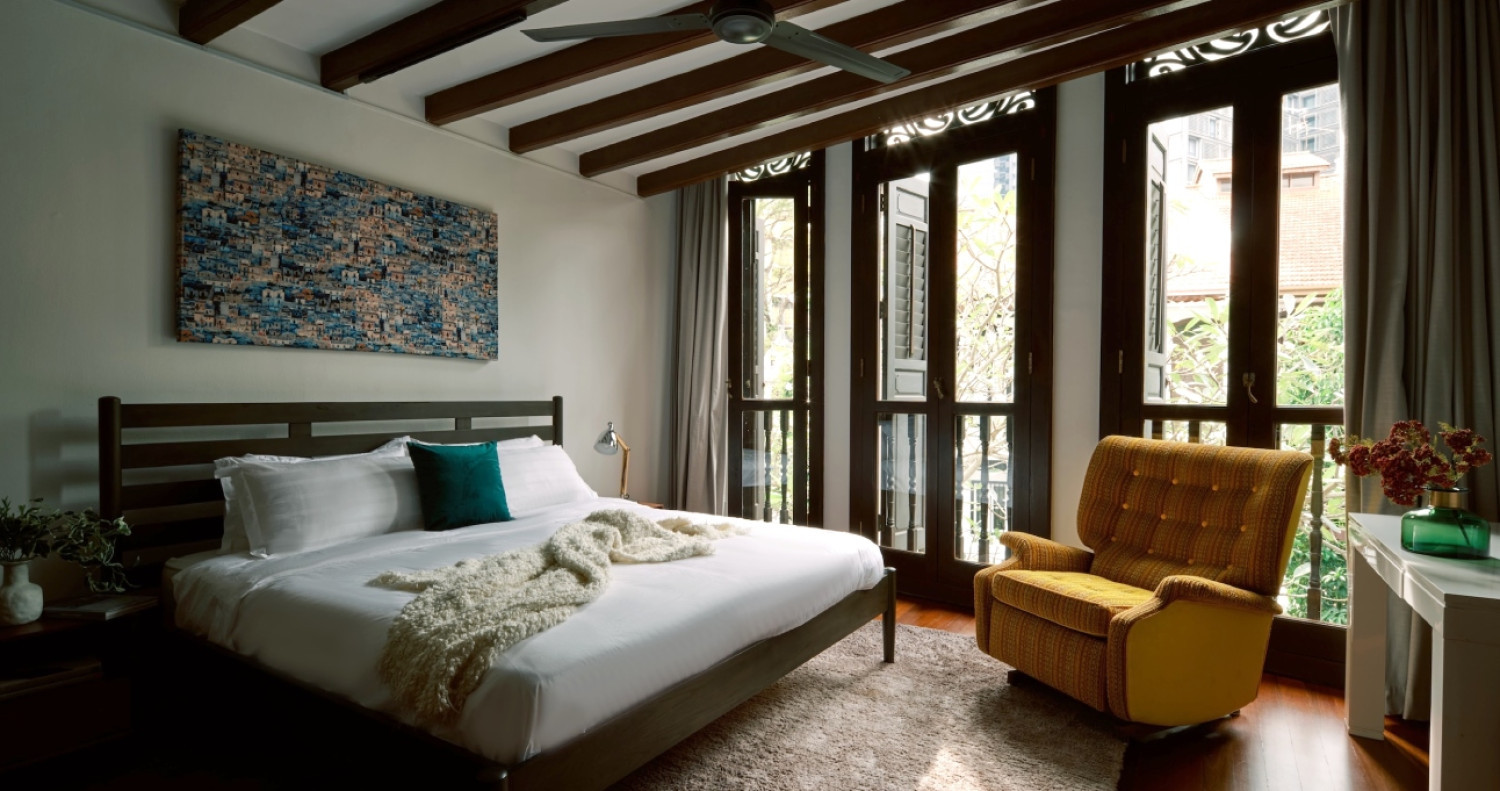
Another co-living firm, Figment — which runs art-infused boutique homes within conserved shophouses in heritage neighbourhoods — has noticed Singaporeans and PRs becoming a meaningful and growing slice of its members.
They make up roughly 20% of its long-stay residents and typically stay for six to 12 months, going by Figment's estimates.
"A few years ago, this segment was almost entirely expats on company packages,” says Fang Low, founder and CEO of Figment. "The local share has climbed as more young professionals treat renting as a deliberate lifestyle choice, not a holding pattern before buying."
Locals, predominantly singles and couples, gravitate towards Figment’s shophouse homes in central heritage neighbourhoods such as Emerald Hill and Jalan Besar, where the character of the building is the draw.
“Most of our members come to us because they want a beautiful base in the city rather than another box on the housing ladder,” Low shares.
Monthly rents for this profile typically run from $3,000 to $4,000. Private en suite studios, with access to the shared living, kitchen and courtyard spaces, are the most popular.
Besides the move-in-ready convenience, Low says the appeal also lies in the character of shophouses in walkable heritage districts — close to food, transport and workplaces, along with the sense of belonging and cultural programming.
“A conserved shophouse with real heritage beats a generic condo unit for the same money,” he adds. “And for this profile, where they live is part of their identity."
Meanwhile, extended-stay demand is showing up across Hong Leong Group’s serviced residence and hotel properties.
At Le Grove Serviced Residences, a wholly owned subsidiary of City Developments, about 6% of guests staying for more than a year are Singaporeans or PRs. They are drawn to its range of fully furnished units, from studios to three-bedroom duplex apartments, says a Hong Leong Group spokesperson.
City Developments' hospitality arm, Millennium Hotels and Resorts, also continues to see sustained demand for long-stay accommodation across its Singapore properties such as La Residenza, Grand Copthorne Waterfront Hotel Singapore, and M Hotel Singapore City Centre.
“These long-stay guests appreciate the convenience of serviced living, with housekeeping, recreational facilities and easy access to business districts and public transport,” the spokesperson adds.
A decade ago, the infrastructure for this kind of lifestyle barely existed at scale in Singapore.
As the co-living and hospitality sectors have matured, their offerings have become more varied and sophisticated. That is making voluntary long-term renting a more viable and appealing lifestyle choice for younger locals.
Family structures and housing priorities
The rise of alternative housing routes also reflects changing household and family structures.
More are staying single for longer, marrying later, or not at all. DINK couples; lesbian, gay, bisexual, transgender and queer (LGBTQ) individuals; and others who fall outside the traditional mould of marriage and parenthood are a growing presence.
Existing housing options do not always cater easily to these varied circumstances.
Tan Ern Ser, adjunct principal research fellow and academic adviser, Social Lab, at the Institute of Policy Studies (IPS), notes that across different household profiles, the desire to own a home largely remains. Build-To-Order flats are still affordable, especially with the significant government grants available.
However, age and income ceiling eligibility restrictions apply to HDB flat purchases, while resale flats have become more expensive and private homes are “easily in the millions”, Tan highlights.
The result is that some may face a narrower set of options, despite having the financial capacity to purchase a home.
SMU’s Wong similarly points out that many Singaporeans still highly value the affordability and cost-effectiveness that flats provide as an accessible pathway towards homeownership.
"On that front, there will be stronger public appetite for reviews of housing eligibility policies such as the age floors for singles and income ceilings for higher-income individuals in the foreseeable future," he says.
Intergenerational wealth and housing security are also at play.
More young Singaporeans today have parents who already own larger homes or multiple properties, Wong notes.
For some, this reduces the urgency and pressure to move out and secure a place of their own. "Thus, what we may anticipate would be more young people bucking the trend of being motivated to simply settle down earlier," Wong says.
A case in point is Rachel*, an LGBTQ individual in her early 30s who works in a senior role in the professional services sector.
With no plans to marry, she has chosen to continue living with her parents, citing their close family ties, and the space and privacy their apartment provides.
Although she had initially considered buying a resale flat, she would only become eligible at age 35 as a single. Homeownership has since ceased to be a priority. "I'd rather put my savings and CPF monies into other investments," Rachel says.
Where finances fit in
Such financial considerations — alongside lifestyle preferences, practical constraints and differing aspirations around homeownership — also influence why some decide not to buy even when they have the means to do so.
Christopher Tan, group CEO of wealth advisory firm Providend, reckons that from a wealth-building angle, renting can make more financial sense when the cost of owning is high relative to the rental alternative, when flexibility has real value, or when the person can invest the difference productively in a diversified portfolio instead of tying everything up in one property.
“This is especially relevant if buying would cause the household to become 'house poor' or leave them unable to invest elsewhere," he says.
Besides, the idea that renting is always wasteful is too simplistic. "Renting is paying for flexibility, not throwing money away," Tan notes.
"Buying is not pure 'saving' either, because ownership comes with interest costs, maintenance, taxes, insurance, renovation costs and high transaction friction,” he adds.
Market conditions can also tilt the balance in favour of either renting or buying.
Wong notes that when the pandemic fuelled a spike in residential rents, more young people actually chose to buy homes, particularly private properties, as it generally made more financial sense than renting during that period.
Now, with rents having stabilised, that pressure to own homes has eased.
Meanwhile, Tan from IPS says that those who choose to rent have likely weighed their lifestyle priorities and other financial commitments, and may have other ways of growing their money.
But he cautions that the rental route also presents potential challenges. There could be "other concerns relating to privacy, costs, length of lease and landlord issues", Tan says.
More ways to call Singapore home
It is safe to say that homeownership will continue to be the default housing aspiration for Singaporeans for the foreseeable future.
But changing household structures, more diverse rental options and evolving lifestyle priorities mean it is no longer the only path that can make sense.
For operators in the living sector, this is a customer segment with different expectations — seeking more than a temporary place to stay, but homes that support how they want to live.
For those pursuing a different housing path, forgoing a property purchase can be a deliberate long-term choice rather than a stopgap.
Among the next generation entering the housing market, the idea of what a home can look like is becoming more varied — with flexibility, convenience and lifestyle sometimes outweighing the traditional pull of homeownership.
*Names have been changed to protect their privacy.