A more expansive life: Why Singaporeans are eyeing retirement in Johor Bahru
Improved cross-border connectivity may strengthen Singaporean demand for Johor homes and rentals, potentially raising prices and rents while gradually narrowing its cost advantage.
Singaporean retirement interest in Johor Bahru is increasingly driven by lower costs and proximity, while the five-minute RTS Link is targeted for December 2026.
Body
Singaporeans Thusitha de Silva and his wife, Sharon Kuok, are marking their 10th year living in Johor Bahru, Malaysia.
“Over the years, our friends have often talked about coming here to retire,” says de Silva. “But it’s mostly just talk.”
The couple first experimented with living in Johor Bahru in 2005, when they bought a quarter-acre (0.1ha or about 10,890 sq ft) plot and built a house at Leisure Farm, a 1,500-acre master-planned gated residential resort in Iskandar Puteri. It’s about a 20-minute drive from the Tuas Checkpoint.
Read also: Home, through every stage of life: A National Day 2026 special
“It was a weekend home, which meant it was quite underutilised,” he says.
Feeling that it was not yet the right time to move permanently, they sold the house in 2012. Over the next few years, however, their desire to leave Singapore grew stronger.
“There was no reason for us to stay, as we have no children and our siblings live overseas,” says de Silva. “Since Sharon is from Johor Bahru, it was her first choice.”
From weekend home to ‘forever home’
In 2015, the couple drove around Johor Bahru with their property agent, viewing houses in neighbourhoods including Horizon Hills.
One day, a house set back behind a long driveway caught their attention. They asked their agent to enquire, and he came back saying the owners might be open to selling.
The owners, an elderly Singaporean couple, were concerned about the weakening Malaysian ringgit, which was then hovering at around RM3 to $1. They wanted to return to Singapore and reduce their exposure to further exchange-rate losses, de Silva relates.
He and Kuok both had “good vibes” about the house.
“When that happens, we usually act on it,” he says. “You could say we are impulse buyers.”
They made an offer on the spot, and the owners accepted it.
The couple engaged the contractor who had built their previous home at Leisure Farm to renovate the house. They moved in permanently on Feb 28, 2017.
Read also: The modern multigenerational home: How some Singaporean families are redefining living together
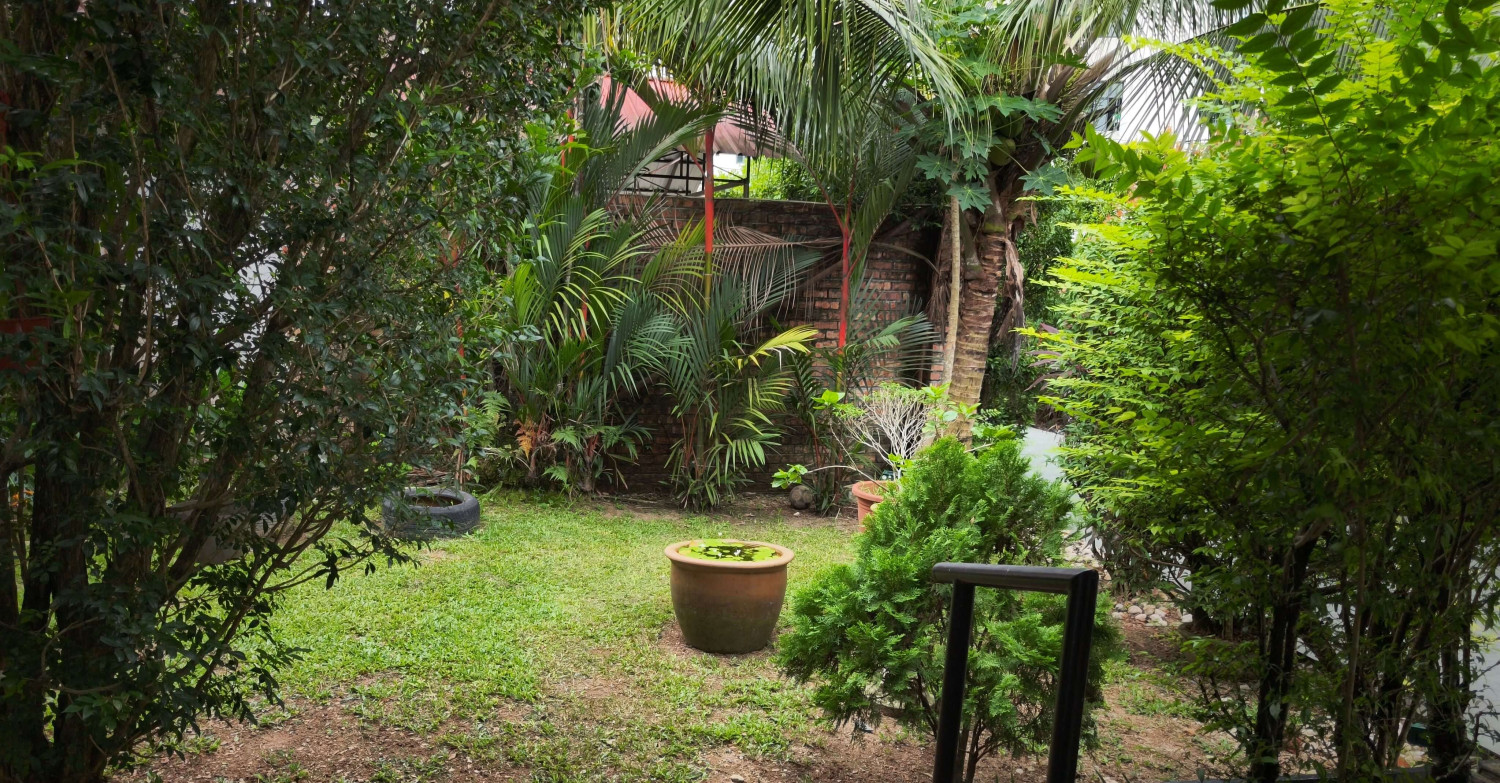
Unlike Leisure Farm, their present neighbourhood is not within a gated community.
“Sharon went mad on security,” says de Silva. “We have barbed-wire fencing, CCTV cameras and a house alarm, in addition to our three dogs.”
The neighbourhood has proven relatively safe, however. The couple have not switched on the alarm since their first few months there.
Proximity, greater connectivity with RTS Link
Proximity to Singapore was another important consideration. Although semi-retired, de Silva remains professionally active. A media and financial advisory professional, he works with the Singapore research arm of global research, analytics and consulting firm Cerulli Associates.
Many of the couple’s friends have considered renting out their HDB flats in Singapore and then renting or buying an apartment in Johor Bahru, he says. A few have bought units there but are not yet prepared to make a permanent move. Instead, they have rented them out or used them as short-term accommodation.
De Silva believes the Johor Bahru–Singapore Rapid Transit System (RTS) Link will make living in Johor Bahru and commuting to Singapore more attractive.
Targeted to begin passenger service by December 2026, the RTS Link will connect Bukit Chagar in Johor Bahru with Woodlands North in Singapore. The journey between the two stations is expected to take about five minutes.
Read also: How school proximity drives property decisions for families
For now, the Malaysia My Second Home programme remains the most common residency route for foreigners, including Singaporeans. De Silva expects less complicated alternatives to emerge, “judging by the growing pipeline of housing projects across metropolitan Johor Bahru”.
“Property developers don’t just build for the fun of it,” he says.
A more organic, cost-driven wave
Alan Cheong, executive director of research and consultancy at Savills Singapore, has observed the cross-border movement of Singaporeans for more than two decades.
The first significant wave came during the 1997–1998 Asian financial crisis, when economic conditions encouraged some Singaporeans to move across the Causeway, he says.
Another wave emerged between 2010 and 2012, fuelled by the development of Iskandar Malaysia and catalytic projects such as Legoland Malaysia, Medini and Marlborough College Malaysia.
“The wave was fuelled mainly by grandiose plans,” says Cheong.
The latest interest is different.
“This time around, it’s not so much about a concept but about cost considerations, which are more organic and sustainable,” he says.
Anecdotally, many of those considering such a move are in their early 50s and either retired or semi-retired, Cheong adds.
‘Best of both worlds’
Like de Silva, Singaporean Boaz Boon is semi-retired but remains professionally active in Singapore through several corporate and advisory roles.
Boon has also mastered the art of crossing the Causeway while avoiding the worst traffic. He drives from Singapore to Johor Bahru at about 5pm on Sundays, after attending church, and returns on Tuesdays, usually in the late morning or early afternoon.
At those times, the door-to-door journey can take just 30 minutes, he says.
Unlike de Silva, Boon did not buy a new home in Johor Bahru. Instead, he redeveloped his childhood home.
His parents bought the freehold property in 1965 for just RM18,000 ($5,644 based on today’s exchange rate). After 15 years with CapitaLand as head of research, Boon decided to leave the corporate world. At 50, he wanted more time to pursue other interests. In 2016, he founded Thred, a real estate and design thinking firm.
That was also the year he decided to redevelop the family home in Johor Bahru.
The entire process, from demolition and reconstruction to furnishing the interiors, took nine months, and the house was completed in time for Christmas that year.
Boon spent about RM1 million rebuilding and furnishing the house. A Singaporean friend, by contrast, recently paid $6.5 million for a semi-detached house on the West Coast of Singapore, and is spending another $1 million renovating it.
The house in Johor Bahru sits on a freehold site of about 4,000 sq ft and has four en suite bedrooms, a mezzanine and enough space for guests. It is designed in the style of colonial-era black-and-white bungalows.
Since their mother passed away in December 2021, Boon’s sister has moved into the house full-time with a helper, while Boon spends several days each week there and other days in Singapore.
Boon and his wife continue to maintain their fully paid executive flat in Choa Chu Kang, which they bought in 1998. Their two sons are grown up.
“I enjoy life on both sides of the Causeway,” he says. “It’s the best of both worlds.”
His monthly household expenses in Johor Bahru amount to about $1,500, or RM5,000, and have remained broadly stable over the past decade. The sum covers groceries, dining, entertainment, insurance, property maintenance and salary for a domestic helper. At that level of expenditure, one can live comfortably just across the Causeway, Boon says.
Will Johor’s cost advantage last?
“Johor stands out among the possible retirement destinations [for Singaporeans] because of its proximity and familiarity,” says Wong Xian Yang, head of research for Singapore and Southeast Asia at Cushman & Wakefield.
Retirees can benefit from substantially lower living costs while remaining close to family and friends in Singapore, he adds. These advantages could become more pronounced following the completion of the RTS Link.
“The combination of improving healthcare standards and lower healthcare costs is likely to be a key draw for retirees,” says Wong.
However, increased demand from Singaporean retirees could gradually erode some of Johor’s cost advantages by placing upward pressure on property prices and rents.
“As a result, while Johor is likely to remain cheaper than Singapore, the extent of the cost-of-living arbitrage may narrow over time,” says Wong.
De Silva already sees “a huge number” of Singapore-registered cars in Johor Bahru during weekends, public holidays and school holidays.
For residents there, however, the constant influx of Singaporeans can be frustrating, as goods and services in Johor Bahru tend to cost more than in places farther north, he adds.
“New F&B outlets are opening regularly and targeting Singaporeans,” says de Silva. “I’ve heard of Singaporeans who go ‘coffee club crawling’. I think it’s pretty evident that business owners are preparing for the opening of the RTS Link.”
‘Potential bottleneck’
While the RTS Link will make travelling between Singapore and Johor Bahru more convenient, Boon is concerned about what will happen after passengers arrive.
“I shudder to think how they might navigate once they arrive at the Johor Bahru Customs, Immigration and Quarantine complex,” he says.
The RTS Link will have a peak capacity of up to 10,000 passengers per hour in each direction.
“Imagine thousands arriving and booking Grab rides — and what happens when there’s heavy rain?” Boon says. “Johor Bahru’s last-mile transport infrastructure still needs considerable improvement. Right now, I foresee a bottleneck on the Johor Bahru side.”
Beyond Johor Bahru
While Johor Bahru benefits from its proximity to Singapore, it is not the only overseas destination attracting Singaporean retirees.
According to Marilyn Tan, head of international residential sales at JLL Singapore, Australia is another popular option, particularly Melbourne and Perth.
“Malaysia continues to attract strong interest because of its proximity, cultural familiarity and affordability,” says Tan. “Australia appeals to those who hold permanent residency or valid visas in the country.”
Within Malaysia, Kuala Lumpur and Penang are also popular, says Adrian Lim, senior director of international residential sales at Savills Singapore.
“In Thailand, Bangkok is another attractive option, while Chiang Mai is gradually gaining interest among retirees seeking a slower pace of life,” he adds.
‘Chaos, convenience — good for the soul’
For de Silva and Kuok, lower living costs, quality of life and Kuok’s roots in Johor Bahru all contributed to their decision to move.
But there were less tangible considerations too.
“The thought of living in a city-state for the rest of our lives was something we couldn’t embrace,” says de Silva.
“We wanted a more expansive life, with a bit of edge, chaos and inconvenience. It’s a spiritual thing — good for the soul.”