Elevate Capital gives 30-year-old Stamford Court a new lease of life as Stamford Place
Early co-working demand and long-term serviced-apartment bookings signal potential for adaptive reuse to unlock value in well-located, undermanaged older commercial buildings.
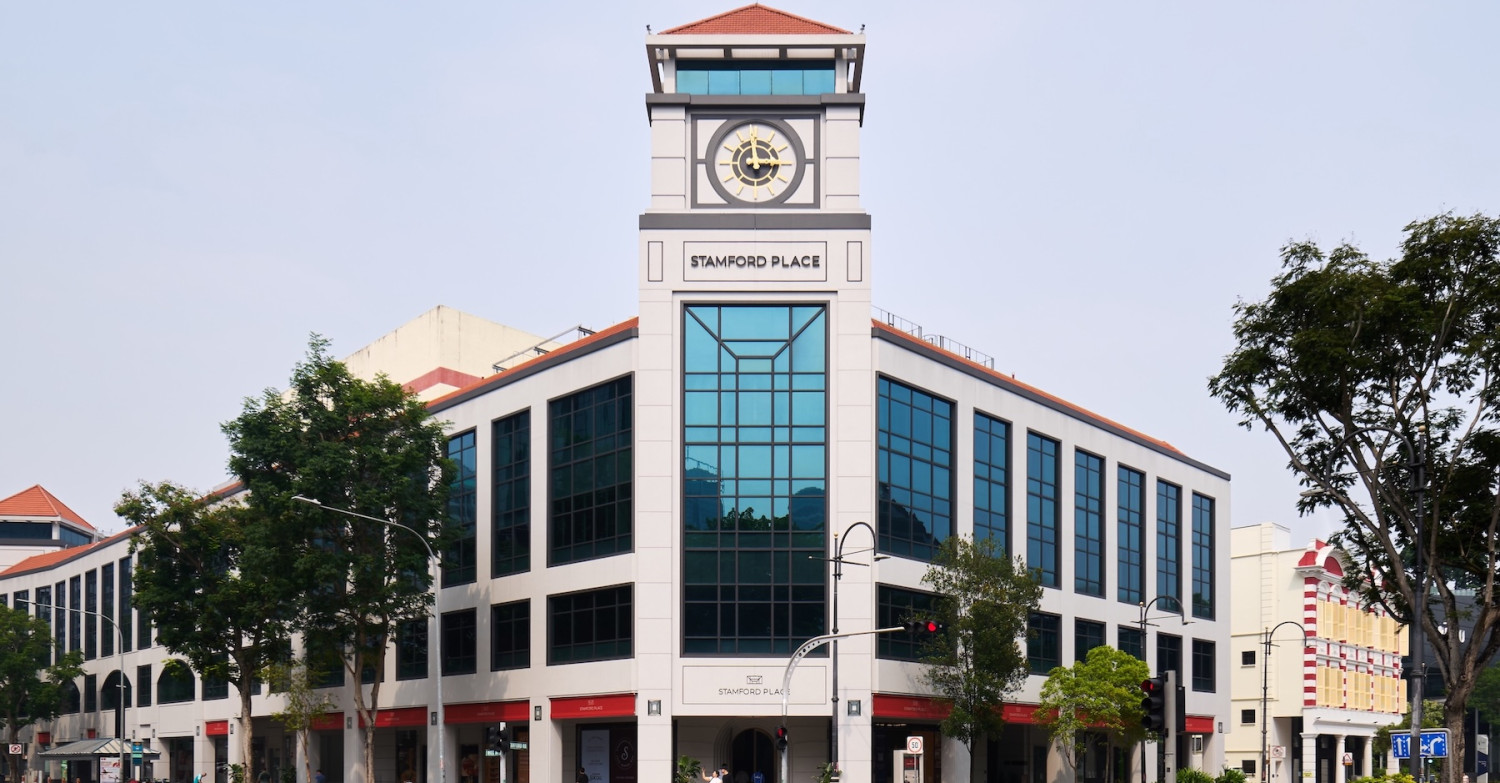
Elevate Capital and PGIM Real Estate acquired Stamford Court for $132 million in October 2024 and repositioned it as mixed-use Stamford Place.
Body
For the past two decades, Singapore Management University (SMU) students crossed Stamford Road to Stamford Court mainly for two reasons: the bus stop in front of the building, or the 24-hour Cheers convenience store at the corner of the four-storey commercial building with the clock tower.
“The whole area was quite dead,” says Randy Chan, principal architect at Zarch Collaboratives, which led the transformation of the former Stamford Court, now Stamford Place.
Elevate Capital, which targets well-located buildings that are 20 to 30 years old and undermanaged, acquired Stamford Court with joint-venture partner PGIM Real Estate for $132 million in October 2024. It sits on a 99-year lease from 1994, with about 67 years remaining.
Search for the latest New Launches, to find out the transaction prices and available units
“We felt that it was a high-quality asset — very central, great location, but trapped in time,” says Ashish Manchharam, founder and managing partner of Elevate Capital.
“We saw the opportunity to reposition the property to cater to the students, those working in the neighbouring office buildings, tourists and also guests from the nearby hotels,” he adds.
Manchharam hopes that the refreshed Stamford Place will be “the catalyst for the area”.
Completed in 1996, Stamford Court had reached the age when many owners begin to weigh tearing down and rebuilding. Instead, its structure was retained, and its granite cladding and clock tower reworked rather than replaced.
To cater to the neighbourhood, a variety of F&B options were introduced in the ground-floor units. They include Blue Label Tavern, which has already opened. It will soon be joined by Gelato Messina, which will host a pop-up by cookie bakeshop Butter, as well as Japanese restaurant Yoruya and Nanyang Old Coffee.
Complementing these is Stamford Social, a 50-seat all-day European-inspired café and bar connected to the lobby of the new Stamford Place. “We need to have a variety of affordable, all-day F&B options to cater to the neighbourhood,” he says.
The ground floor will also house a wellness concept and Cold Storage On The Go, the supermarket chain’s new small-format store.
Read also: Orchard Road must double down on community and experiences to remain Asia's premier lifestyle destination
The three upper floors now house a co-working space run by The Great Room and 66 serviced apartments under a new serviced apartment brand, APT, created by Elevate Capital.
Even before Stamford Place fully opens, early indications suggest strong demand, with The Great Room co-working space continuing to be filled. APT has already secured long-term bookings. Given its proximity to the track, it has also taken week-long stays for the Formula 1 Singapore Grand Prix 2026 from Oct 9 to 11, notes Manchharam.
Updating for modern-day use
Zarch worked alongside the Ministry of Design (MOD), whose founder and director of design, Colin Seah, led the design of the exterior refresh and the interiors.
For Zarch, the main challenge during the refurbishment was converting the former office building into a mixed-use development with serviced apartments. Bathrooms had to be fitted in every unit across all floors, and approvals had to be obtained from various government agencies before work could start.
As a result, construction began only in October 2025 and was completed at the end of August. The entire interior was gutted, leaving only the lift core and the building’s structural shell, says Chan.
The building’s reddish-brown granite cladding, similar in tone to Ngee Ann City’s, was unmistakably of the 1990s. Removing it, however, risked damaging the waterproofing and windows, says MOD’s Seah. Instead, façade specialist Building Façade Group applied a textured, stone-effect coating over the existing granite, giving the building a lighter grey finish.
Read also: Stamford Place will open in September after revamp, with serviced apartments, workspaces, dining, culture
“We wanted the façade to be stately, akin to our neighbours,” says Seah. He is referring to the historic buildings of the Civic District around Stamford Place. Among them are the Vanguard Building, Stamford House (now part of The Capitol Kempinski Hotel) and the Peranakan Museum.
The Vanguard Building and Stamford House were both designed by Regent Alfred John Bidwell, one of Singapore’s most influential colonial-era architects. Bidwell is best known for Raffles Hotel and the Victoria Memorial Hall (now Victoria Concert Hall).
At Stamford Place, the most prominent feature is the clock tower, which Zarch renovated. “We cleaned up the clock, gave it a new mechanism, and it now has a new lease of life,” says Chan.
The main entrance has also been repositioned, says MOD’s Seah. Designed as “a layered arched portal”, it now sits directly beneath the clock tower as the building’s focal point. Previously, that spot was occupied by Cheers, while the main entrance was tucked away at the side, “which was very odd”, he adds.
Both Zarch and MOD had worked with Manchharam when he led real estate investment firm 8M Real Estate. MOD had designed the interiors of the conservation shophouse at 28 Stanley Street. Meanwhile, Zarch worked on several adaptive reuse projects involving conservation properties, including the former Eu Yan Sang Building on South Bridge Road and conservation shophouses at 111 Jalan Besar as well as Tanjong Pagar.
Of time and place
Stamford Place’s site has a long history. The corner of Stamford Road and Hill Street was once occupied by Eu Court, built in the late 1920s by businessman Eu Tong Sen. It was demolished in 1992 to make way for road widening works along Hill Street and Victoria Street. Singapore Land Group acquired the site in 1994 and completed Stamford Court two years later.
While the exterior of Stamford Place is now light grey, the interior palette is terracotta, reminiscent of the roof, floor and veranda tiles of the black-and-white bungalows designed by Bidwell, says Seah. “The whole spirit of the brand — APT and The Great Room — is about celebrating the human scale, and being warm and welcoming.”
The clock tower also inspired a theme of time that runs through the interiors. It is reflected in the horology-inspired LED chandelier in the lobby, and in the hourglass patterns on the upholstered leather panels lining the bar counters at Stamford Social, the concierge reception and The Great Room’s drawing room. “Once we nailed down the narrative with everyone, it became the North Star of the project,” says Seah.
Artworks by Singapore-based artists follow the theme. The common areas will feature works by Richard Hassell, co-founder of architecture firm Woha and an artist focused on textiles, rugs and three-dimensional architectural installations; Samuel Xun, known for his ornate sculptures, installations and textile compositions; and artist, designer and ceramicist Genevieve Ang. Meanwhile, the serviced apartments will display prints by visual artists and muralists, including Soph O and Bblob.
Work and stay under one roof
The Great Room by Industrious has taken about 30,000 sq ft across all of Level 2 and half of Level 3. Since The Great Room was acquired by US flexible workplace provider Industrious in May 2022, its other locations have been rebranded under the Industrious name.
However, The Great Room name was retained for Stamford Place as “it resonated with the overall building concept in terms of positioning”, says Manchharam. It is therefore positioned as “a white label brand”, similar to APT.
He expects occupancy at The Great Room to stabilise at about 90% by early 2027.
The APT serviced apartments occupy half of Level 3 and the entire Level 4. The 66 apartments are managed in partnership with Frasers Hospitality.
Rather than a corporate-style offering, APT is positioned as “an upscale serviced apartment with a boutique-hotel feel”, says Manchharam.
The surrounding area already has plenty of hotel rooms, he adds. Across Stamford Road are the 350-room Pullman and The Capitol Kempinski, with 155 rooms and suites. The 940-room Carlton Hotel Singapore is on Bras Basah Road, while further down at Funan, co-living property Lyf Funan has 329 units.
APT, however, is aimed primarily at guests with a minimum stay of a week. “We want to provide a space for those who want to stay longer, and therefore prefer to have home-like amenities,” says Manchharam.
Units range from studios to suites, with sizes averaging 35 sqm (377 sq ft). There are also dual-key units of about 50 sq m (538 sq ft), which include a common vestibule with a seating area, a pantry with a microwave oven, and a minibar refrigerator. These dual-key units cater to families.
The rooms have high ceilings and full-height windows, now fitted with a second layer of glass to reduce noise and glare. The walls and ceilings have also been acoustically treated. “We want to ensure that people can have a good night’s sleep,” says Manchharam.
Promotional rates are said to start at $268 per night, and are expected to stabilise closer to $300 for the entry-level studios, he adds. The expectation is that occupancy rates will stabilise at the “mid-80%” by early 2027.
APT guests share a gym on Level 3 with The Great Room’s members. They can also use its drawing room and book its meeting rooms.
“We wanted to have a more dynamic building; that’s why we wanted The Great Room and APT spaces to be integrated, so it feels more like a live, work, play environment,” says Manchharam.
Wider catchment
With 500 desks and 66 apartments, the building will accommodate 500 to 600 people when fully occupied, Manchharam estimates. The F&B outlets, however, are intended to draw not only Stamford Place’s occupiers but also people within a 50m to 100m radius — what he calls “our primary catchment”.
That includes SMU, which has more than 13,000 undergraduates, postgraduates and researchers, as well as guests at The Capitol Kempinski and Pullman. Furen International School will be taking over the neighbouring Vanguard Building as its new campus, while Sembcorp Industries’ headquarters is nearby at 30 Hill Street.
Just behind Stamford Place, the pedestrianised Armenian Street and the Peranakan Museum draw tourists, while Fort Canning Park is a short walk away.
Both Manchharam and Zarch’s Chan have tried out APT for themselves. Chan stayed over a weekend with his family. “We were tourists for a day,” he says. “The location is wonderful — you can walk to Raffles City, the museums, and even catch the light show during the Singapore Night Festival.”
During his stay, Manchharam went for a 7am run past Armenian Street, looping through Fort Canning Park and back.
Longer stays help serviced apartment guests get to know the area, says Chan. “When you have people staying for two to four weeks, they will start to understand and explore the neighbourhood.”
Tenant curation at Stamford Place has focused on operators already established in Singapore. “We wanted tenants with a track record for quality and the ability to bring people back as well,” says Manchharam. “The pricing also has to be managed, so it’s affordable for everyone.”
The Blue Label Tavern is a casual dining concept by Travis Masiero Restaurant Group, best known for Luke’s Oyster Bar and Chophouse. It specialises in stone-fired pizzas, dry-rubbed rotisserie chicken and beer on tap. Happy hour runs until 6pm, while the restaurant stays open until 10.30pm from Mondays to Saturdays. “Students from across the street can come here to grab a beer and dinner after class,” says Manchharam.
Manchharam lunches at Blue Label Tavern regularly and has run into groups from the National Gallery and Sembcorp, as well as SMU lecturers and families with young children. “It is a wide mix, and gives you an idea of the type of people who are in the area as well,” he says.
Stamford Social, meanwhile, is targeting the breakfast-to-evening crowd, operating as a café in the morning before switching to happy hour later in the day.
Merchant House
Elevate Capital’s second repositioning play is 51 Merchant Road, which it acquired jointly with LaSalle Investment Management for $121.8 million in February 2026, below the property’s market valuation of $152.7 million. Formerly occupied by Raffles Education, the four-storey building will be renamed Merchant House.
Omnicom has signed a five-year lease, with an option to renew, for 50,000 sq ft across the upper floors and the two adjoining rows of conservation shophouses fronting Fisher Street.
Manchharam plans to convert the building’s large atrium into “part F&B, part wellness”. Refurbishment is expected to take about 18 months.
The building sits on a 99-year lease from May 15, 1993, with about 66 years remaining. It is opposite City Developments’ Union Square, a 735,500 sq ft mixed-use redevelopment of the former Central Mall and Central Square, due for completion in 2029.
Manchharam sees Merchant House as a different proposition from Stamford Place. While Stamford Place is an integrated mixed-use development, Merchant House will be part of a larger mixed-use precinct anchored by Union Square.
Human scale
Elevate Capital continues to hunt for properties priced below replacement cost. “After refurbishment, we are still at a good price point,” says Manchharam.
Its sweet spot is buildings with a gross floor area of 50,000 to 100,000 sq ft, such as Stamford Place, at about 78,190 sq ft, and Merchant House, at 71,111 sq ft. “We are looking at properties that are of a human scale,” he says.
He also sees room to grow the APT brand, focusing on properties with 50 to 150 rooms.
Singapore will remain Elevate Capital’s main focus, but the firm will be “more opportunistic” overseas. One market Manchharam is watching is Hong Kong, where he lived for three years, over a decade ago. “I feel like the market is coming back,” he says. “We can see an uptick in terms of demand for commercial space.”
For now, there is plenty to work with closer to home. Many buildings in Singapore are reaching the 20- to 30-year mark, when owners must decide whether to retrofit or tear down and rebuild, says Zarch’s Chan, who is a founding member of the Singapore chapter of Docomomo, an international non-profit that documents and conserves modern-movement architecture.
Some may choose to sell instead. This is where Manchharam sees opportunity. “There are a lot of older buildings out there that are undermanaged,” he says. “We are looking at what we could potentially do with these buildings, and how we can reposition them, instead of redeveloping.”
Check out the latest listings for Stamford Place properties