Johor landed homes: What's attracting Singaporean buyers and what they should know
Stronger landed-home appreciation and shrinking completed inventory signal healthy absorption and constrained supply, which may support prices and attract Singaporean retirement or second-home buyers.
Johor terraced-house prices rose 7.2% annually from 2016 to 2025, versus 1.9% for high-rise homes, while Johor Bahru’s unsold completed stock fell to 307 units.
Body
Johor's landed housing market has recorded substantial growth over the past decade, supported by the Malaysian state's expanding economy, rising investments and improving connectivity with Singapore.
These factors and trends are adding to interest in Johor's residential property market, including among Singaporeans considering landed homes across the Causeway for retirement or as a second residence.
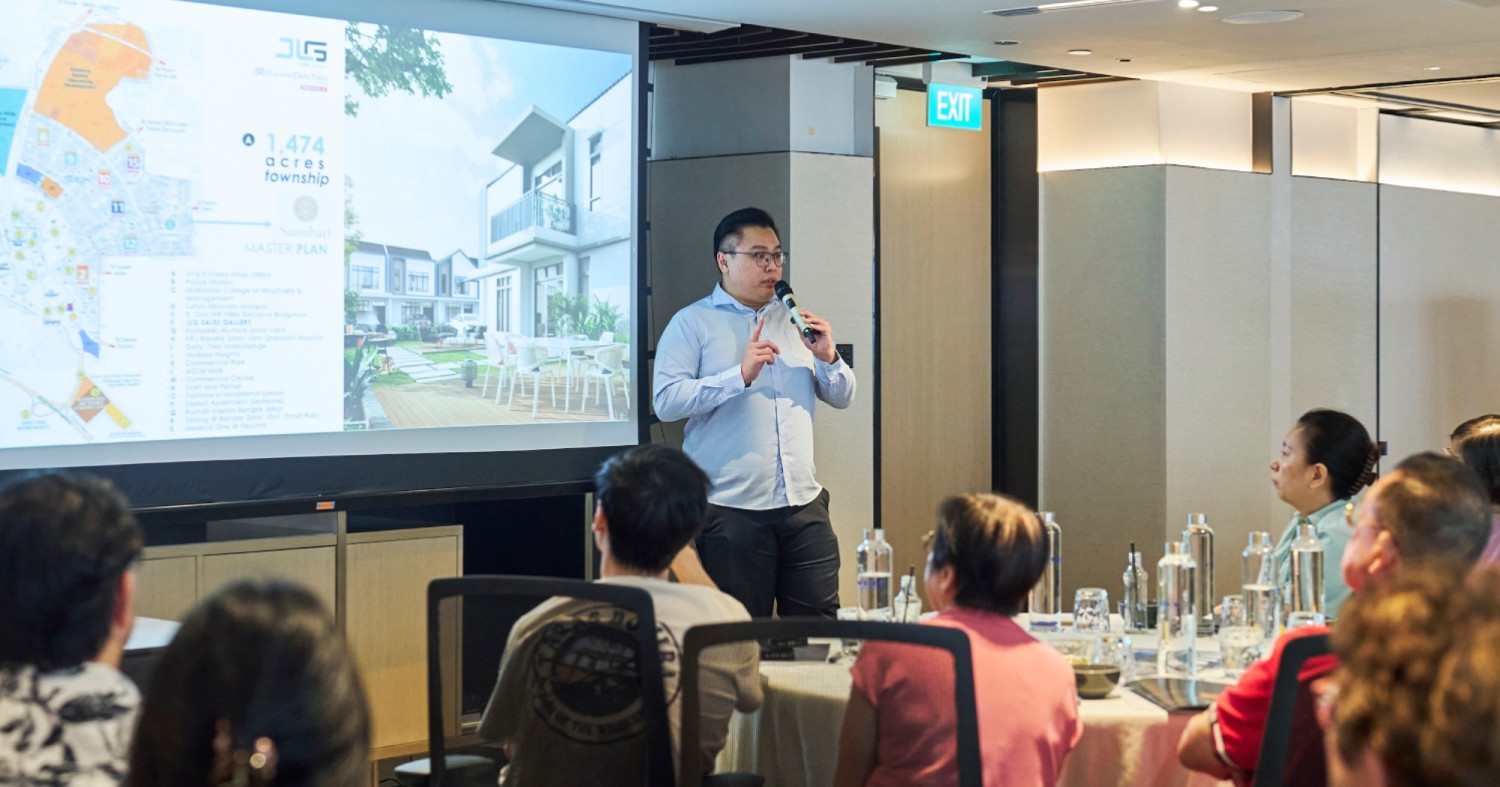
The opportunities in Johor's property market and what Singaporean buyers should know before making a purchase were explored at a two-day event in Singapore organised by JLand Group (JLG) and EdgeProp Singapore on Oct 17 and 18.
Read also: What's moving the market: Singapore's biggest property deals and hottest searches (Oct 16)
The event featured presentations by Ng Ming Yang, property research analyst at EdgeProp Singapore; Vincent Kek, sales manager, JLG; Chan Fei Loong, senior partner, Lim Soh & Goonting Advocates & Solicitors; and Ryan Khoo, co-founder and director, Alpha Marketing.
They covered topics including Johor Bahru's economic and property market outlook, the appeal of landed homes to Singaporean buyers, JLG's Sanubari development at Bandar Dato' Onn, and the legal requirements and considerations for foreign purchasers.
The discussions also explored how retirement plans, the Malaysian ringgit and the upcoming Johor Bahru–Singapore Rapid Transit System (RTS) Link could influence interest in the market.
Audience members also took the opportunity to engage the speakers in lively question-and-answer exchanges during each session.
Strong economic growth, deepening integration with Singapore
Johor's residential market has benefited from the state's economic expansion, with the state’s real gross domestic product growth outpacing Malaysia's national average in recent years.
In his analysis of the property market, Ng from EdgeProp Singapore highlighted Johor’s economic performance and the stronger price growth recorded by landed homes compared with high-rise properties.
Read also: What's moving the market: Singapore's biggest property deals and hottest searches (Oct 9)
The state’s economy grew 8% in 2025, outpacing the nationwide 5.2%, according to data from the Department of Statistics Malaysia.
Johor also attracted the highest investments across all states last year — surpassing the likes of Selangor, Kuala Lumpur and Penang — and made up 26% of the country’s total approved investments.
Of this, foreign direct investment accounted for a large share for Johor, totalling RM60.52 billion ($18.97 billion), compared to RM35.06 billion or less for the other three.
"It shows that international companies have confidence in Johor," said Ng.
"Global tech firms such as Nvidia, Microsoft and ByteDance are choosing to set up data centres there, and the state is also attracting investments in other high-tech industries such as manufacturing and semiconductors."
Moreover, Johor and Singapore are set to become more integrated amid bilateral commitments, namely the upcoming Rapid Transit System (RTS) Link, and the Johor-Singapore Special Economic Zone.
Connectivity in particular will be a catalyst, with the RTS Link expected to open in February 2027, improving travel between Johor Bahru and Singapore.
Read also: Sanubari Phase 4A brings smart, spacious landed living to Bandar Dato' Onn
"The RTS offers more certainty in terms of travel time," Ng said. "That's quite crucial because you can start going beyond the Johor Bahru city centre and go somewhere less dense, with more peace and quiet."
Terraced homes outperform high-rise properties
Meanwhile, Johor's landed housing market has performed more strongly than its non-landed or high-rise residential segment.
Prices of terraced houses in the state have grown by 7.2% annually from 2016 to 2025, increasing every year including during the Covid-19 pandemic.
In contrast, prices of high-rise homes have lagged, rising by 1.9% annually over the past decade. They only recovered to pre-pandemic levels in 2025.
Within Johor, its capital city Johor Bahru and Kulai exhibited the highest terraced property price growth during the last 10 years, at compound annual growth rates (CAGR) of 9.3% and 8% respectively.
The supply picture also differs: terraced houses in Johor face far less incoming supply than high-rise units, relative to existing stock.
In Johor Bahru, the number of unsold, completed terraced houses has been declining steadily over the past five years, shrinking from 1,150 in 2021 to 307 in 2025.
“The supply of terraced homes in Johor is tight, and there’s quite a healthy absorption,” Ng noted.
Freehold landed homes in an established township
For prospective buyers in Singapore, the appeal of Johor's landed housing market often depends on the location, surrounding amenities and type of homes available.
At the event, Kek from JLG introduced Sanubari, a freehold landed residential development within the group's established 1,474-acre (597ha) Bandar Dato' Onn township in Johor Bahru.
The 762-unit project's latest release, Phase 4A, comprises 105 double-storey terraced houses, each with four bedrooms and four bathrooms and spanning built-up areas of 2,160 sq ft.
They offer space for larger households, including families and those considering a second home in Johor.
Prices range from about RM1.3 million to RM1.95 million.
The freehold properties carry individual titles, as opposed to strata titles, and sit on either corner or intermediate lots measuring 20 feet by 70 feet (6.1m by 21.3m).
Kek noted that the first three phases of the project are fully sold, with the launch of the final Phase 4B, comprising 117 units, targeted for the end of this year.
Sanubari “blends nature, technology, community and personal space”, which fosters wellbeing and purpose, he added.
Buyers are attracted to the project’s community-focused design, active lifestyle facilities, smart home automation system, as well as ample green spaces and landscaped areas.
The homes are equipped with rooftop solar panels, can be fitted with EV charger points and come with parking for two to three cars. Residents can enjoy an exclusive clubhouse, pool and central park.
In the vicinity are Aeon Mall and Fairview International School, with healthcare accessible at the KPJ Bandar Dato’ Onn Specialist Hospital, highlighted Kek.
Unlike newer projects in relatively undeveloped locations, Sanubari in Bandar Dato' Onn is nestled within a “very mature” suburban area of Johor Bahru, he added.
It sits near other established residential and commercial townships including Taman Mount Austin, Taman Daya, Taman Setia Indah and Bandar Jaya Putra.
Bandar Dato’ Onn has 5,827 existing and committed residential units thus far, and is well-connected with convenient access to the surrounding neighbourhoods and the North-South Expressway.
JLG’s plans for Bandar Dato' Onn go further than Sanubari. The township will also include the upcoming Calmore Estate and Calmore Hills developments, which are projected to bring onstream 6,101 units.
What Singaporeans should know before buying
Johor's landed homes may appeal to Singaporeans considering a second residence or looking to retire across the Causeway.
However, prospective buyers need to be aware of the restrictions and requirements governing foreign property ownership in Malaysia, including those specific to Johor.
Chan of Malaysian law firm Lim Soh & Goonting outlined the key legal and procedural considerations for Singaporean buyers.
These included stamp duty, real property gain tax, eligible property types, inheritance, key contractual terms when purchasing residential properties, reselling in the future, Bumiputera release lots, and ownership restrictions.
One of the key rules in Johor is the state’s minimum purchase threshold of RM1 million for foreign buyers, Chan highlighted.
Among landed residential properties in Johor, Singaporeans can purchase terraced, cluster, semi-detached and detached houses that are two storeys or higher, as well as vacant bungalow lots, though foreign ownership quotas and state consent requirements apply.
Chan also delved into the sale and purchase agreement as well as the respective obligations of developers and purchasers for new-launch units.
As for the Malaysia My Second Home (MM2H) initiative, he explained that it is not mandatory before buying any property in the country, though a property purchase is required when applying for the programme. MM2H is a long-term residency initiative by the Malaysian government for foreigners.
For buyers unfamiliar with the property market in Johor and Malaysia, these requirements are important to understand before entering into a transaction.
Retirees, ringgit and RTS
Lifestyle preferences and retirement aspirations are also influencing Singaporeans’ keen interest in Johor Bahru, with the city’s proximity to Singapore and lower living costs among the factors fuelling demand for homes across the Causeway.
Khoo of Alpha Marketing focused on three key drivers of Johor Bahru's real estate market: retirement, the Malaysian ringgit and the upcoming RTS Link.
Retirement in Johor Bahru is attractive to Singaporeans for a few reasons, including the numerous cultural similarities. "Many things in Malaysia are familiar because we have similar foods and languages," Khoo noted.
He reckoned Singapore's ageing population will likely contribute to demand and more residents would want to retire across the border, where living expenses are generally relatively lower given the strength of the Singapore dollar.
Johor Bahru's access to retiree-friendly leisure activities and services is also a strength.
"Malaysia is a big country with a large hinterland and forests. If you stay there, you can very easily reach places like Sabah, Malacca and Kuala Lumpur," Khoo said.
The geographical proximity is another reason Johor Bahru appeals, and improved connectivity with the upcoming RTS Link is set to make cross-border living even more feasible.
For Singaporeans retiring or spending part of their time in Johor Bahru, the short distance allows them to travel between the two cities frequently without the need for air travel.
They can maintain their social and family ties in Singapore while enjoying the lifestyle across the Causeway.
Khoo gave an example of grandparents who could be spending most of their retirement in Johor Bahru while making regular trips back to Singapore to visit their children and grandchildren.
"You can go to Johor Bahru in the morning to have your dim sum and walk around, and return to Singapore by night to play mahjong with your friends. The next day, you may head to Johor Bahru again for a dental appointment and then come back to Singapore to see your children."
He described this as "effectively living in two cities" and having the best of both worlds.
That said, he also encouraged prospective buyers to assess their requirements, intended use of a property and their reasons for wanting to purchase it.
They ought to consider questions such as: Will you drive in Malaysia? How will you manage the property? Who will live with you? How will you enjoy your home and the neighbourhood? When will you need to exit?
Whether buying a home to live in or as an investment, Singaporeans will need to weigh the potential benefits of owning property in Johor against the responsibilities and practicalities involved.