One Devonshire's resident-led approach to asset enhancement initiatives
The resident-led focus on useful amenities, energy efficiency and cost discipline may strengthen the 152-unit freehold District 9 condo’s appeal while moderating maintenance-cost increases.
One Devonshire’s owners approved a $200,000 function-room refurbishment within an approximately $1 million annual asset-enhancement budget, with the three-month project completed on Sept 5.
Body
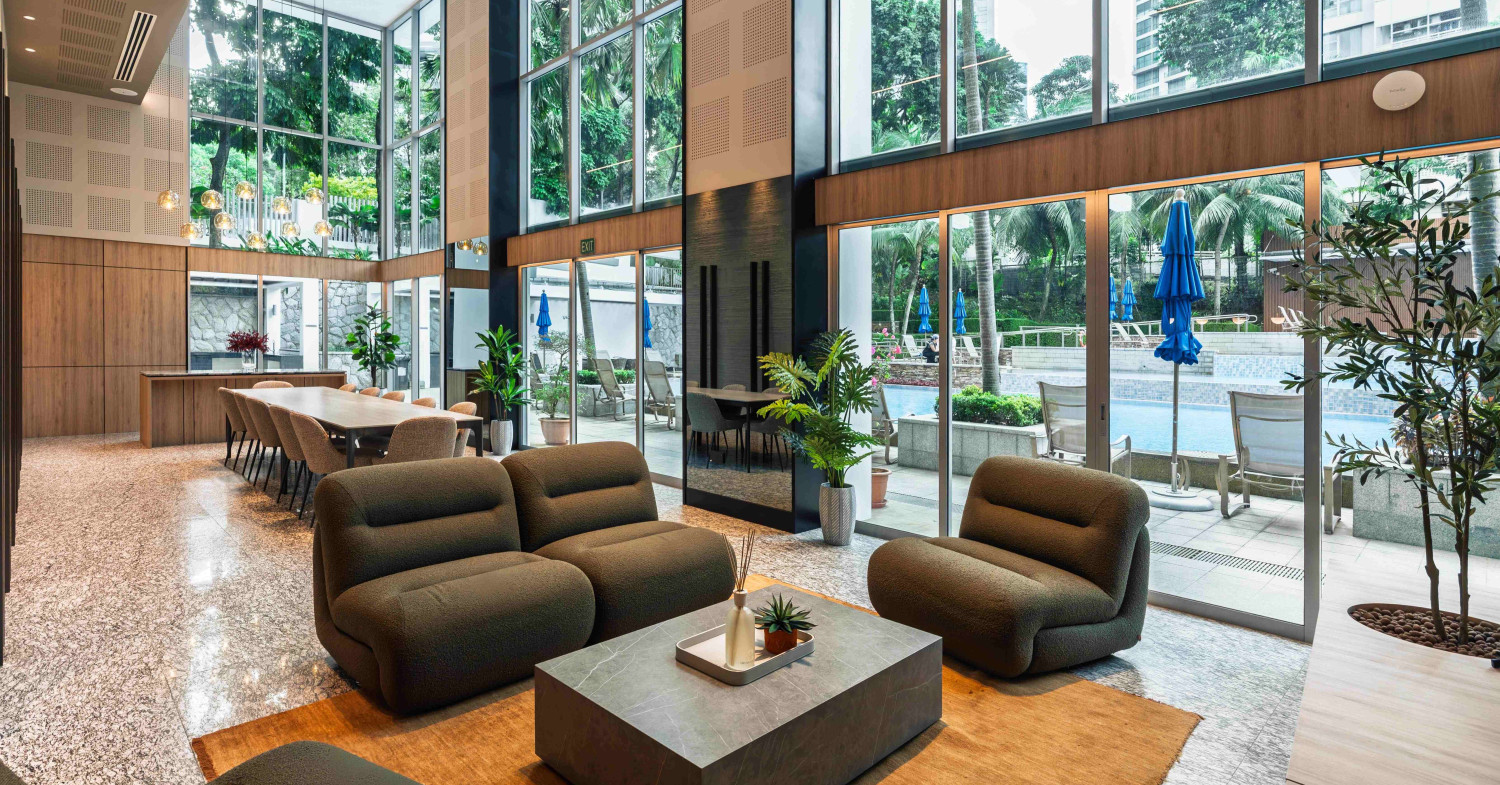
At One Devonshire, a 152-unit freehold condo off Killiney Road and St Thomas Walk in prime District 9, the recently refurbished function room is designed like an open-plan luxury apartment, with a triple-volume ceiling and full-height windows opening onto pool views.
On entering, residents step into a comfortable lounge area with a widescreen television. Next to it is a dining table that seats 18 for a formal sit-down dinner, while a bar counter anchors the other end of the room.
Behind a partition wall is a kitchen fitted with wood-finish cabinetry, a long stone countertop and backsplash, a sink, a built-in oven for reheating food and a refrigerator.
Read also: Is it a good deal? Resale buyer picks up freehold District 9 Klimt Cairnhill unit at new low of $2,836 psf
Karen Lim, chairperson of One Devonshire’s management corporation strata title (MCST) council, sees the refurbished function room as “an extension of your home” — a place where residents can dine, work, watch movies or entertain more people than their apartments may comfortably accommodate.
“If you think of inviting friends over, the first thing you do is start to tidy up your home and make it look nice,” she says. “But here, with the function room, it’s all ready for you.”
It wasn’t always this way.
From echo chamber to ‘great room’
The refurbishment of the function room dates back to One Devonshire’s annual general meeting last October, when its MCST council was given a budget of about $1 million for asset enhancement initiatives (AEIs) for the financial year.
Most of the money was allocated to repainting the 36-storey condo tower and common areas, as well as applying an epoxy floor coating in the carpark. The committee also planned repair and replacement works for common areas and facilities.
One issue raised at the AGM was the function room. Its ceiling height, bare walls and floors, and full-height glass windows running the length of the room made for poor acoustics.
“The acoustics were quite bad,” says Lim. “Sound used to echo around the room, and when there were many people inside, you could barely hear each other talk.”
Read also: Freehold District 9 apartment block Cavenagh Fortuna on the market for $60 mil
The room was also furnished with wicker furniture that was better suited to outdoor use.
The members passed a special resolution to refurbish the function room, with the seven-member council initially seeking a budget of $150,000.
The subsidiary proprietors (SPs) attending the AGM were so supportive that they increased the budget to $200,000. Some also wanted to be involved in the project.
A subcommittee was subsequently formed to oversee the refurbishment, including two resident SPs who had supported the motion.
Besides Lim, council members Lee Min Yin and former MCST chairman Yip Ying Ee have also been closely involved in One Devonshire’s wider AEI programme.
Beyond aesthetics
When selecting an interior designer, the subcommittee considered five firms recommended by council members, the managing agent Edmund Tie & Co. Property Management Services, and SPs that had worked with them previously.
Rather than simply asking the designers to come up with attractive concepts, the committee drew up a questionnaire setting out what the refurbishment was expected to achieve.
Read also: High Point condo relaunched for collective sale at $580 mil, marking fifth attempt
Its brief centred on three priorities: improving the acoustics, reducing energy consumption and creating an interior with a neutral, enduring palette rather than something overly fashionable.
“We wanted something evergreen, not trendy,” says Lim.
Four of the five firms submitted proposals, which the committee evaluated through a blind scoring exercise to minimise the influence of personal recommendations.
Singapore-based interior design firm Cream emerged with the highest score by a significant margin, according to Lim. Some competing proposals had focused heavily on aesthetics without adequately addressing the room’s acoustic or energy efficiency issues.
The committee also considered the firms’ credentials, previous MCST projects, and whether they had their own contractors, given the tight timeline to complete the work before One Devonshire’s AGM scheduled for mid-September.
Cream had previously handled AEIs at high-end condos including The Loft @ Nassim, The Pier @ Robertson, UE Square Residences, One Jervois, Aalto on Meyer Road and Marina Bay Residences. Its ongoing projects include The Sail @ Marina, RiverGate and Marina Bay Suites.
The resulting design addresses both the room’s acoustics and energy consumption.
Instead of replacing air-conditioning equipment that had been changed only five years earlier, Cream lowered part of the ceiling and shifted the air-conditioning diffusers closer to the occupied area so that the room could cool more efficiently.
William Goh, founder of Cream, also used specialised acoustic boards on the ceiling and walls to reduce echo, while a new rough-textured wall helps minimise sound reflection.
The design was also intended to make the large-volume room feel more intimate.
“We did this by lining the lower part of the room in warm timber cladding and lowering part of the ceiling above the entrance to the function room,” says Goh. “This way, one experiences a gradual increase in ceiling height as they move towards the main hall space.”
Lim and Lee took a more proactive approach on the furniture selection. They used AI to overlay the selection on the initial design to see how it would look. The revised furniture selection was then shared with the committee and Cream.
They chose olive-coloured lounge seating from Castlery instead of the cream pieces Cream originally proposed.
“We thought the colour combination was richer and added more depth to the space,” says Lim.
They were equally particular about the tone of the textured wall, asking Cream to apply actual samples so they could see how the finish would look in the room.
The colour of the aluminium bars installed across the feature wall was too light, and also deviated from the original design, says Lee. “We told them we needed a darker tone.”
The result is an interior with greater depth, anchored by a mix of textures and tones.
The refurbishment took three months, from May to July, and the completed function room was handed over to ETC on Sept 5.
‘Hands-on’ council
“We are very hands-on,” says Lim, who has chaired the management council at One Devonshire for the past two years.
Lilian Oh, director of Edmund Tie & Co. Property Management Services (ETC), which has managed One Devonshire for the past 11 years, agrees.
“This is certainly one of the more hands-on councils I have come across,” she says. “The level of involvement and time commitment is quite significant.”
At the same time, Oh says being hands-on has to be balanced with the council’s role in providing direction and oversight, while allowing the managing agent and appointed professionals to advise and manage the process objectively.
“Ultimately, the aim should be to ensure the works are carried out transparently, efficiently and in the best interests of the MCST,” says Oh.
An asset-management mindset
Lim previously worked for a UK investment bank and has experience with Reits, which gave her a grounding in asset enhancement strategies. She spent many years in London before returning to Singapore.
ETC’s Oh says Lim’s experience has helped shape her approach to the condo’s AEIs.
“She is quite clear on what needs to be prioritised and tends to look at whether the benefits justify the cost before spending the MCST’s money,” she observes.
That shared understanding of the need to balance the estate’s requirements against cost also makes it easier for the managing agent to work with the council, Oh adds.
Six of the seven council members are residents. “If you don’t live here, it is harder for you to understand and help identify the operational issues of the estate,” says Lim, who has lived at One Devonshire since 2014.
“The SPs are the asset owners,” she adds. “We are responsible for how we want to steer the AEI.”
According to Lim, about 65% of the units at One Devonshire are investor-owned and tenanted, while only about 35% are owner-occupied.
Making shared spaces work harder
The same focus on making shared amenities more attractive and useful to residents is shaping improvements elsewhere in the development. A little-used playroom has been converted into a multipurpose room where residents can work or take conference calls, with a bench table set up by the window.
That instinct to rethink how existing spaces and furnishings are used extends beyond the function room and multipurpose room.
At the lobby, for instance, Lim says that simply moving a cluster of chairs from one corner to another improved both the look of the space and how often residents used it.
The council is also reviewing One Devonshire’s seven themed sky gardens to see how they could be made more useful for gatherings and other activities.
Some, including the Japanese- and Chinese-themed gardens, have already been refreshed. Furniture previously used in the function room has been moved outdoors, where its hard-wearing materials are more suitable.
The two larger gardens — the Mediterranean Garden on the 13th floor and English Garden on the sixth floor — offer alternatives for parties and gatherings.
The council is also considering replacing some plants to open up views from the gardens.
The Japanese Garden on the 26th floor, for instance, overlooks Marina Bay and Marina Bay Sands.
“A lot of residents come up here to watch the fireworks on National Day,” says Yip.
At the Rock Garden on the ninth floor, a bouldering wall sees little use because residents require an instructor before they can climb, owing to safety requirements.
So, part of the garden is being turned into a herb garden, while the council is considering alternative uses for the bouldering wall.
Technology — with an eye on costs
Technology has become another tool in the council’s decision-making. Lim frequently encourages managing agent ETC to use AI to streamline workflows and improve productivity.
A feature wall facing the jacuzzi pool, for instance, was first visualised using AI. The rendering helped the council settle on a warmer treatment incorporating timber-look finishes and greenery.
Council member Yip, an engineer by profession, proposed using aluminium cladding with a timber-like finish because it would be more durable. He subsequently tapped one of his contacts for a supplier that could provide the material at what the council considered a reasonable price.
The AI rendering had also suggested incorporating the One Devonshire name prominently on the feature wall.
The council liked the idea — until it found out how much it would cost. It was promptly dropped.
“We always think: ‘Should we spend the money on this? Is it crucial?’” says Lim. “If it’s not so crucial, then perhaps not.”
As the development, completed in 2011, enters its 15th year, that discipline is becoming more important.
While maintenance costs are increasing, passing every cost increase on to owners is “not sustainable”, says Lim. “There are ways to do things without spending a lot of money,” she adds. “If we can use technology to reduce some of these costs, then I think it’s a win-win for the condo.”
One example is the move from manual facility bookings to the iCondo app. Residents can now make reservations digitally, while the management team can pull usage data directly instead of having staff compile it manually.
Motion sensors have also been installed for lights in some common areas, while lighting hours in the gardens have been shortened to reduce energy consumption.
From ‘wish list’ to priorities
Every year, council members draw up what Lim calls a “wish list” of improvements.
Each item is assessed according to its cost and potential benefit to residents before projects are prioritised and, where necessary, put before owners for approval.
“If we don’t do that, then it will be very random, because there is no thought process that went into it,” she says.
The process also means some ideas have to wait, even if council members would like to pursue them.
“We have a lot of plans, but the money is not infinite,” says Lim.
Check out the latest listings for One Devonshire, District 9 properties