Dunearn House Sold 56% At Launch — But One Unit Type Sold Out Completely
Strong demand for flexible family layouts contrasts with the 75.8% average launch take-up in 1H2026, potentially signalling buyer fatigue and growing resistance to higher prices.
Dunearn House sold 212 of 380 units, or 56%, over July 25–26 at an average $3,140 psf, with both three-bedroom configurations fully sold.
Body
More than half of the units at the 380-unit Dunearn House, the first condominium to launch in the new Bukit Timah Turf City precinct, have been sold following the end of the project’s sales weekend from July 25 – 26.
According to various marketing agencies, at least 212 units (56%) were snapped up by buyers, with the Three-Bedroom and Three-Bedroom + Flexi units selling out completely. Meanwhile, nearly three-quarters (43 units) of the Two-Bedroom + Study were sold, with buyers also picking up 89% of the Four-Bedroom units.
Overall, the project set an average selling price of $3,140 psf.
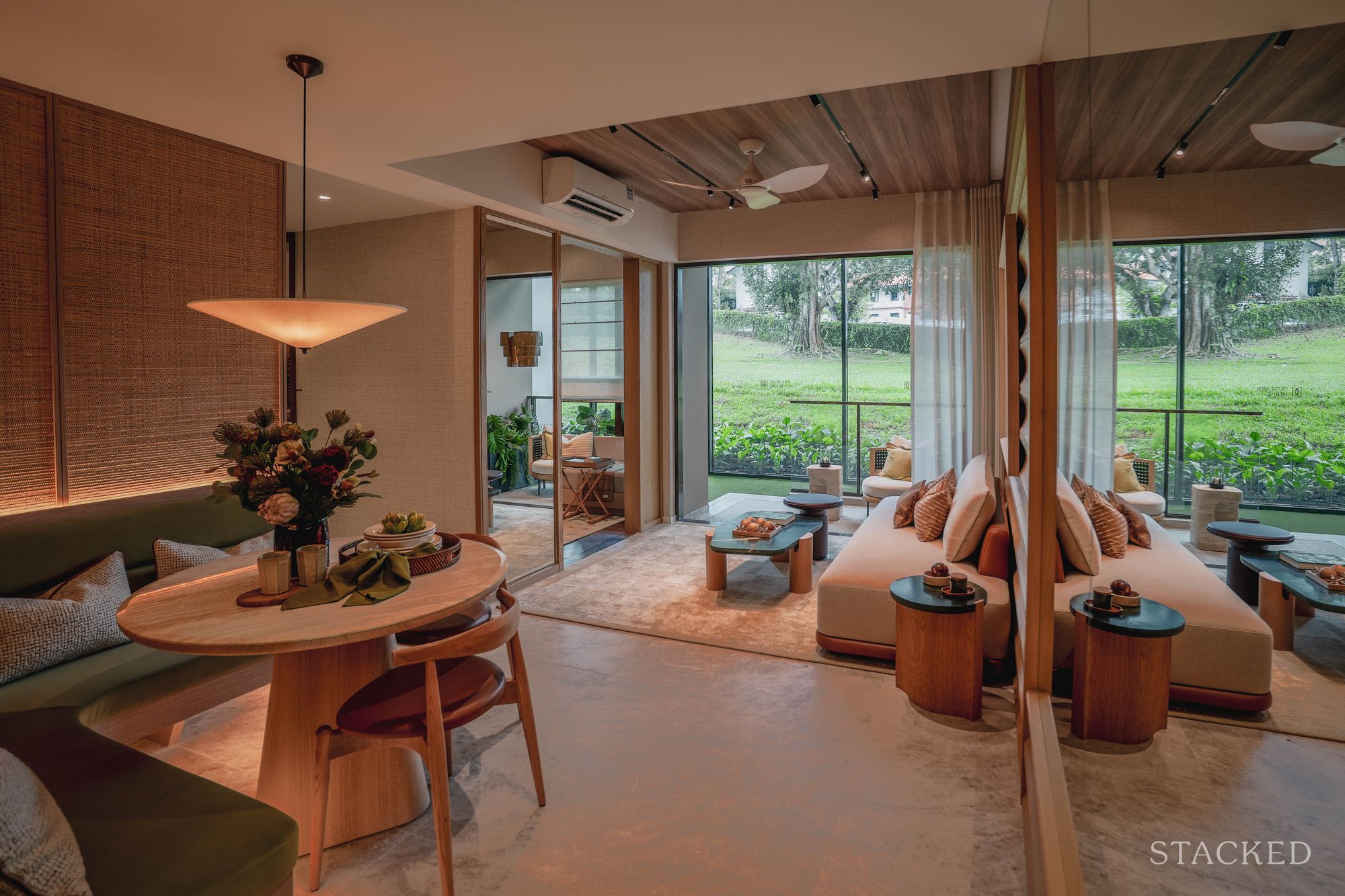
Dunearn House sees a take-up rate of 56% as the first residential launch in Bukit Timah Turf City masterplan. 212 of the 380 units were sold at an average price of S$3,140 per square foot. (Picture: Frasers Property)
Buying demand was fuelled by owner-occupiers who jumped at the chance to own the first new condo in the new precinct, aiming to capitalise on the long-term uplift that would likely accompany the new public-private residential district. There was also pent-up demand for new 99-year leasehold condos in Bukit Timah, which also contributed to the overall buying demand for Dunean House.
“Dunearn House is not entering a greenfield location. It is launching within an established Bukit Timah residential ecosystem, offering buyers first-mover exposure to the longer-term transformation of Bukit Timah Turf City. This combination of existing locational attributes, address prestige, and future growth potential is relatively uncommon among new precinct launches,” says Marcus Chu, CEO of ERA Singapore.
He adds that most of the buyers are families who already reside in Bukit Timah, Holland Road, and other neighbouring estates. They are mostly upgraders looking to move into a new development while staying within a familiar neighbourhood, says Chu.
Dunearn House is the first condo, and first residential development, to break ground at the new Bukit Timah Turf City.
In general, most Bukit Timah residents tend to stay within or around this prestigious area. Chu points out that many households are connected to the area through schools, family ties, or long-standing residence, sometimes spanning generations. “This loyalty drives demand from families upgrading within the district, landed homeowners looking to right-size, and parents buying homes for legacy reasons,” he says.
But there was also a notable contingent of HDB upgraders. According to data by ERA, these buyers likely originate from nearby Queenstown, where an increasing number of million-dollar flat transactions have boosted their ability to upgrade to private housing.
Over the first six months of 2026, there were 120 million-dollar flats transacted in Queenstown, with an additional 173 million-dollar flats sold in that town last year, according to research by ERA.
Justin Quek, Deputy Group CEO of Realion (OrangeTee &ETC) Group, says that the selection of units during the sales launch reflects a clear buyer preference for layouts offering supplementary study or flexi areas, which hit the pricing sweet spot between $2 million and $3.8 million.
“A notable observation at the launch was the significant presence of young buyers accompanied by their parents. This highlights that parental support was a key factor in securing these units and played a major role in driving the rapid sales of the project’s Two-Bedroom + Study and Three-Bedroom units,” says Quek.
Moreover, the relative scarcity of new 99-year leasehold condos in this vicinity also prompted decisive action by buyers over the last two days, says Quek.
The Two-Bedroom + Study units at Dunearn House were among the top picks for buyers, with 73% of this unit configuration sold this weekend.
However, Nicholas Mak, chief research officer of Mogul.sg, points out that there have been nine new project launches with 4,854 units which have entered the market in the first half of this year, and developers enjoyed an average take-up rate of 75.8% during the launch weekend.
“The approximately 56% sales rate of the two most recent condominium launches pale by comparison to the earlier launches,” he says, referring to the 54% sales rate at Lentor Gardens Residences by Kingsford Group last weekend.
Mak notes that most of the new project launches in March and April 2026 recorded exceptional strong take-up rates of about 90%, such as River Modern and Tengah Garden Residences.
“If the residential launch take-up rate of about 56% achieved by the two most recent major launches becomes the new benchmark for private residential projects, developers would have to adjust their sales expectation and pricing strategy for the upcoming housing launches,” says Mak.
However, he opines that another reason for the relatively lower sales rate seen during the most recent two launches could be an early indication of both buyers’ fatigue and resistance to the sharp increase in property prices in the new launch market.
In the last 18 months, property developers have launched 39 residential projects with 17,917 housing units, which equate to an annual injection of 11,945 units of new condo units. In contrast, the annual average demand for private homes in the primary market over the past five years is 8,766 units, according to research by Mogul.
Mak suggests that it is possible that some buyers feel inundated by the volume of new residential launches in the past year and a half. “Hence, the property market needs more time to digest the relentless supply of new residential units,” he says.
He adds that each new private residential project has usually launched at higher prices than the preceding comparable residential projects in the vicinity, and suggests that some developers are attempting to expand the price envelope.
“However, developers would eventually have to come to terms that there is a limit to the size of the homebuyers’ bank account and investment appetite,” says Mak.